
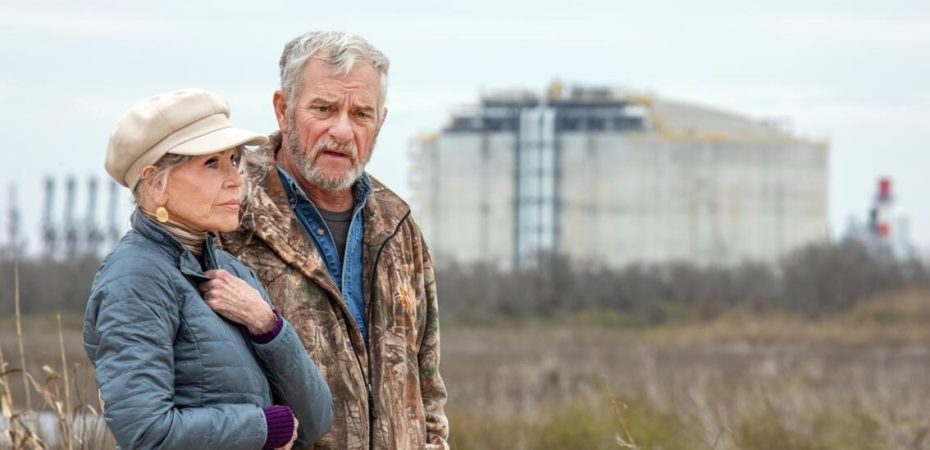
Directed by Katie Camosy, Jane Fonda travels across the oil fields of West Texas’ Permian Basin and through the Gulf Coast of Louisiana visiting the communities impacted by oil and gas production. Also featuring: Connie Britton and Maggie Rogers.
Within Gaslit there are many different issues and messages but there’s one that stands out above all and that is: you should be angry. You should be outraged and disgusted by this wilful, egregious damage being done to communities and the environment. It’s an important reminder, as the film very aptly demonstrates, it takes a movement, it takes people getting out there and vocally caring about their communities for authorities and governments to actually do something about it.
That’s really the heart of Gaslit, within its exploration of the issues and consequences of oil and gas production, it’s a portrayal of activism, its impact and how it brings people together from different sides of the divide. Brought together by the extent of the damage being done, it’s certainly eye-opening to see the casual way in which so much irreparable damage is done to the environment and how it disintegrates the communities surrounding those plants.
Something the documentary does well to highlight is how it disproportionally impacts Black neighbourhoods. As well as how land which has been in families for generations, or livelihoods passed down from parent to child for countless years, are having to be abandoned because their value and quality of life has been destroyed. Effectively creating poverty, while convincing people that it’s in their best interest and will generate jobs or tax breaks, or other empty incentives.
There’s a really great variety of people interviewed for Gaslit which is lovely to see, particularly because they are all incredibly passionate. It was also a nice choice by Katie Camosy to not put Jane Fonda permanently front and centre, to let these people talk for themselves and their communities while she takes a step back. Although Fonda adds a strong emotional note, being outwardly moved by the plight of everyone she meets, and furious at the injustices unfolding, particularly in Texas.
All of that is interesting to watch, but Gaslit is let down by its style. Coming in at just over an hour and fifty minutes, it feels a touch drawn out, and part of that is because there’s no evolution to the tone. It can feel like a lot of the same after about the first hour, despite the fact that all the subjects do have plenty to say and add, the conversations start to blend into one. It also has quite a sentimental tone, it’s missing a sharpness to drive its fury more impactfully.
Gaslit highlights an extremely necessary, poignant issue of damage being done that likely can never be undone and the climate and economy will face the consequences for many years to come. There’s a great mix of subjects, it’s surprising just how little oversight there is and how many violations can be spotted without ever setting foot in the plants. The documentary makes clear that the American people, as well as the wider world, should be angry about this, and need to be. It simply lacks a sharper style to hit the powerful notes that it calls out for.

