
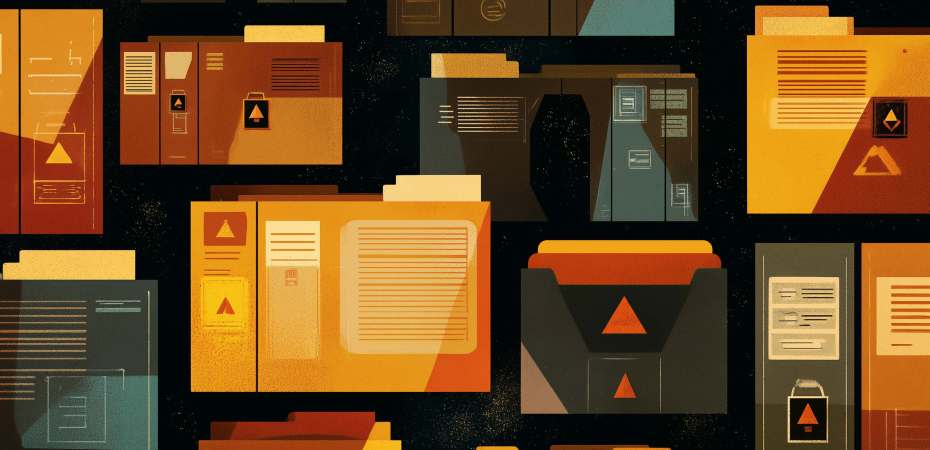
Written and directed by Marco Milone, an essay documentary on digital surveillance, from ARPANET to the Internet of Things, from cybercrime to blockchain, asking not just how these systems work but who they ultimately serve. Everything on screen is constructed: diagrams, schematics, typographic cards, geometric animation. There are no interviews and no protagonist beyond a flat geometric silhouette. Made by one person with the same AI tools it critiques.
The biggest conversation which The Power of Data opens up is one of awareness and complacency, and it’s a vital one. Many years back there would be jokes made about signing user agreements from giant corporations which were so long that no reasonable person would ever read them, and that who knows what we were truly signing away. Marco Milone examines that idea with this short documentary.
He asks a number of questions surrounding the inevitable consequences of handing over our data at the click of a button, and how commonplace that has become. Meaning that privacy is no longer a simple expectation, it has become a luxury of sorts which is increasingly more difficult to get hold of. One which requires a serious level of vigilance, if it’s even really possible at all in this day and age for people who wish to have some form of online presence, whether that be gaming, shopping, social or otherwise.
As well as touching upon the harrowingly shrinking number of companies and people in control of how that data is handled, versus the gargantuan number of people providing that data. It has a lot of extremely relevant points to make, and the way that the information is provided would be particularly helpful to show people who don’t have an awareness of the issues, as it would make for a great introduction. It’s concise and accessible, especially as it’s hitting upon multiple issues within its less than twenty-minute runtime but never feels overstuffed. It flows very well and avoids ever becoming convoluted or overly technical.
The idea of using AI tools while creating a film which criticises them is an interesting one, but in action the impact doesn’t feel that strong. It does work, but it makes less of a statement than expected. With the focus being much wider than those tools, it needed a more vocal element to connect their use with the message of The Power of Data. The use of text onscreen could also be tidier, especially in that opening statement, stretching it completely over the screen makes it harder to read.
The generated voice works surprisingly well, it does waiver in points and the tone isn’t entirely consistent, but the crafted delivery is nicely dramatic. The delivery can occasionally be a little too slow, which highlights that artificial nature. However, otherwise the visual and audio elements have a good sense of creativity, the animation has a good variety of visual styles and colours used throughout. They make for something that’s easy to focus on while the emphasis remains on the narration. Although during its pauses for extra emphasis, especially the first example, it might have been helpful to alter the visual to accent it rather than a simpler pause.
The Power of Data is a strong reminder of how frequently and easily we are giving away all of our information and what it’s worth, which is an inherently relevant, vital topic. Marco Milone does well to hit upon a number of different issues within the topic, without ever feeling like it’s rushed. The delivery is calculated and effective, the documentary has a good flow to it, and it holds a simplicity of sorts, to deliver its message in a concise manner. It has a good dramatic edge to it, and as Milone’s directorial debut it demonstrates a good grasp on communication and an admirable desire to approach this familiar topic in an original, meta and practical way.
Verdict: ✯✯✯½ | 7/10
For more info visit thebaronmilone.com
The Power of Data was an Official Selection of 4th International Experimental Film Festival (IEFF) in Athens, received an Honourable Mention at the 7th Luminous Frames Film Festival & alongside festivals, the film is available for organisations, conferences and universities to request it for a screening or presentation

