
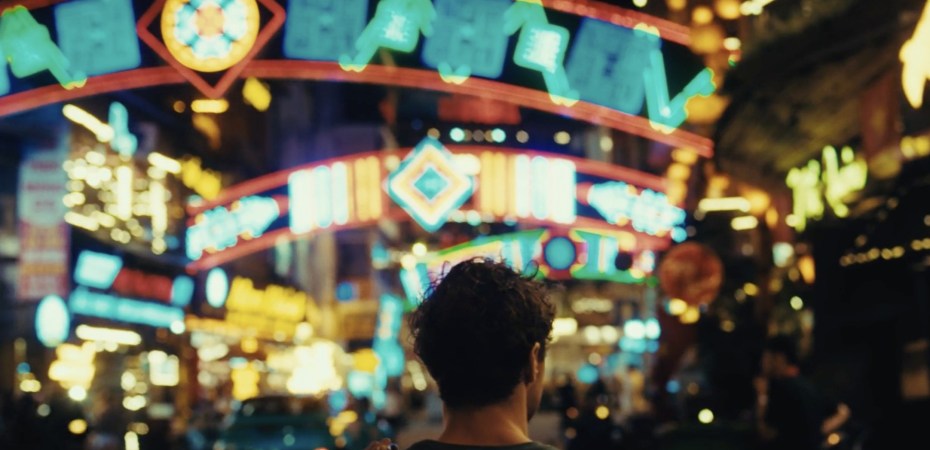
Written and directed by Coz Greenop, a young, disillusioned writer, travels through Vietnam in search of inspiration after the death of his wife. Amidst the vibrant chaos of Hanoi, Aron begins to write his wife back into existence, desperately clinging to the memory of the woman he lost. Starring: Jack McEvoy and Jessica Truong.
The most obvious strength of The Last Room in Hanoi is one that’s apparent from the second it opens, and is unwaveringly consistent until the credits roll, and that is its truly gorgeous aesthetic. The cinematography from Gary Long is exceptional, it’s effortless to watch. It’s filled with such satisfying colours, it’s incredibly rich, there’s a boldness to it but also a warmth. These remarkable visuals are exactly the type where you can simply bask in everything they have to offer. While that’s pretty much always something you want to craft for your film, it’s particularly purposeful with The Last Room in Hanoi as there is no dialogue.
Granted, that choice will not work for everyone, it requires a certain amount of patience, and in that sense it’s a risky move. There are a lot of filmmakers today who are going to feel the pressure to adjust their films to suit a modern audience with social media addled brains and decreasing attention spans, but there are also some who withstand that pressure and Coz Greenop is clearly one of them. So, while some may not appreciate his choices here, others will enjoy its quiet, reflective nature.
It has a deeply contemplative tone, and a great natural flow, but it does also have some unexpected elements. There are quite a few aspects to the story that are entirely open to interpretation, which works really well. Using that restrained style means that the audience is already trying to piece things together, so adding in some surprising elements, deepens that further. There are clues to help you along, it isn’t leaving viewers completely in the dark, its emotional communication is well done. The direction from Greenop, along with the lovely score from Julian Winding do well to translate the mental state and reflections of The Last Room in Hanoi’s protagonist.
That removal of dialogue also presents an interesting challenge for the film’s actors, to again communicate all of those emotions and conflict without using words. Jack McEvoy and Jessica Truong’s performances match the restrained tone of The Last Room in Hanoi overall. There’s a great sense of loss, longing, love and the fleeting nature of life. They’re understated and graceful, creating a chemistry that is evident but light, never falling too far into traditional romance.
The Last Room in Hanoi is beautifully shot, it’s effortless to be swept away by its seductive visuals, filled with such satisfying accents of colour, depth and vivacity. It holds a compelling, captivating presence, and moves with a sincere confidence, never outwardly trying to compensate for that lack of dialogue. The locations are terrific, and Coz Greenop really makes the most of them with his strong shot choices. It’s unusual, pensive, original and that aesthetic is genuinely stunning.

