
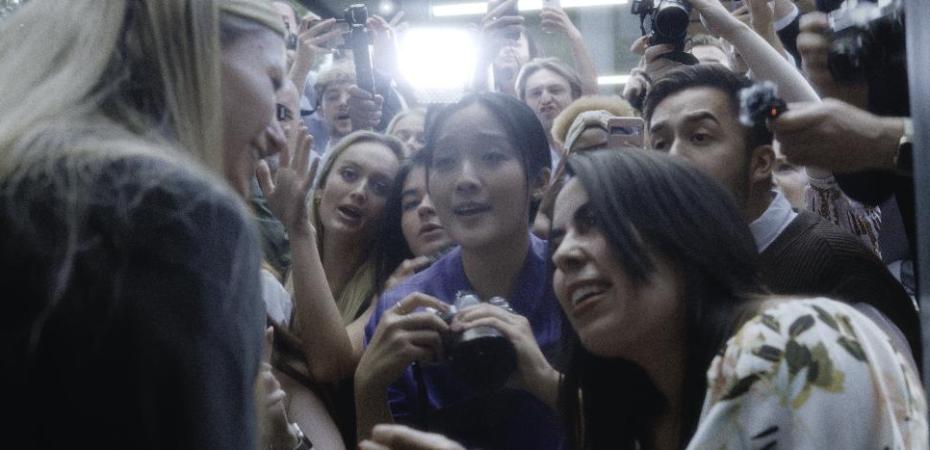
Written and directed by Thomas Ward, Debbie Scott, an influencer turned film producer, clings to the crumbling illusion of her studio’s success. Until reality itself begins to fracture, forcing her to confront a truth no amount of editing can fix. Starring: Jane Lee Jones, Andrew Norman, Freddie Cohen, Emily Moment and Olivia Thackray.
A vital part of successfully making a film on an indie budget is having a strong awareness of the elements of your story which actually need to be explored onscreen, and how much can be achieved by using the audience’s own imagination to fill in the blanks, The (First) Last Screenplay is a very good example of that.
There are so many elements of this story, like Debbie Scott’s (Jane Lee Jones) past, other projects, and social media which could have been included, but they weren’t needed. It’s great to see Thomas Ward recognise that, especially as this is his debut feature, and to keep the film contained and make choices which are both effective and budget and time conscious.
Another key element is recognising all of the technical aspects which can make a big difference, one being the score. Charlie Flint provides an excellent one, it’s understated and impactful, it really nicely feeds into The (First) Last Screenplay satisfying air of suspicion and conspiracy. Another being the location choices, the sets are kept simple but styled to build that feel of just enough success and potential, with the occasional extra accent when it’s needed.
Similar could be said of the cinematography, which also comes from Thomas Ward, it’s very consistent and exists strongly within a grey, blue-ish palette. It adds a certain coldness and distance which matches the tone of The (First) Last Screenplay very well.
It pairs with the film’s waning grip on reality, its sadness and that sense of there being a lot of smoke and mirrors at work. Something which is in turn supported by the intentional repetition in Ward’s shot choices, it’s a really effective formula when it’s done correctly, as to not actually make the film feel repetitive, and instead make you question the reality, which Ward achieves.
That surreal edge to The (First) Last Screenplay also works well to tell the different layers of this story. On its surface being one of a struggle for success, while tackling an emotional tale beneath of grappling with the idea of losing someone who plays a pivotal part in your life. Having the mystery at the forefront while building something sincere beneath was an interesting choice, that works surprisingly well.
Although while the majority of the film holds onto a subtlety and an understated style, there are a couple of choices in the later scenes which slightly undermine it. It goes a touch overboard in one of the film’s more intense scenes and throws off the tone, which was a shame to see. It can also occasionally lean a little too much on that fractured style to the editing, the intention is certainly there, but it’s one of those times where less is more.
Jane Lee Jones provides a good lead for the story, bringing capable, crafty and hustler qualities to Debbie, while also giving her a vulnerability. It’s a good blend, and the strength of her performance lives within the quieter moments, matching the understated tone of the film overall. When the film tries to more overtly explore the emotional side of things, it can weaken. She’s well paired with Andrew Norman as Richard, the two create an interesting relationship, and Norman adds a good organic touch of intensity.
The (First) Last Screenplay is a solid debut feature from Thomas Ward, it plays out with a satisfying air of mystery and brings through a lot of natural notes of conspiracy and suspicion. It plays out with a slow-burn and does so confidently. It makes a lot of great choices to build its atmosphere and aesthetic effectively, without trying to achieve something outside of its budget, which is always lovely to see. It’s tense, curious and well executed.

