
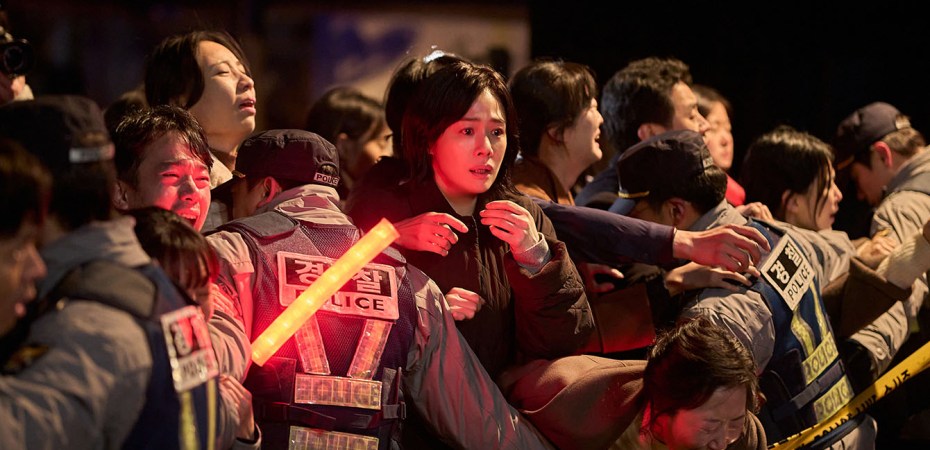
Written and directed by Yeon Sang-ho, co-written by Ryu Yong-jae, based on the novel Black Inferno by Oh Seong-eun. A bus full of children mysteriously vanishes. a grieving mother’s son miraculously returns nine years later, she must grapple with the technologically revised reality which she has created. Starring: Kim Hyun-joo, Bae Hyeon-seong, Kim Jong-tae, Lee Hyun-kyun, Lee Yoo-joo, Yu Ji-wan, Koo Kyo-hwan and Kim So-wan.
It’s easy to see how with Paradise Lost, Yeon Sang-ho was attempting to take a beloved formula of South Korean thriller cinema, and add a new spin. However, ultimately the elements of the film which are the strongest, are the familiar ones. The introduction of AI and asking fairly tired questions about sentient awareness and emotion, and the over-reliance or addiction to technology as compensation for real life pain, although the latter is certainly much more relevant, doesn’t have a great deal to add.
As you watch this story develop, and all of the great tension it has to offer following the return of Sun-Woo (Bae Hyeon-seong), and the sincere darkness he brings to the table, you start to wonder, why the AI vein was even necessary? That the same story could have likely been achieved without it, with only minimal changes. Granted, without it there isn’t much original writing going on, but there’s nothing really wrong with that. Use the formula, it’s tried and tested, audiences love it, it doesn’t need to reinvent the wheel. You might not create a masterpiece of cinema, but that’s not the bar here.
So, unfortunately the success of Paradise Lost is fairly divided, had it stuck to the foundation of this story, skipped over the AI, and given it more time to throw in twists and turns, this could have been great. However, despite being shot well, with strong cinematography (from Song Hyun-suk) and an excellent atmosphere which is captivating and consistent, that facet to the story becomes a distraction and hinderance. The result being that it gradually becomes frustrating viewing, it becomes harder to reconcile their choices, and to see the logical path.
Another key element is providing the explanation of what happened to the children, no-one wants to watch a feature all the way through, only to find that there’s no answer to the film’s key mystery, and with Paradise Lost you will find an answer. Although, it’s not a hugely satisfying one and a very minimal amount of time is spent upon it. Again, something that could have been explored further if it weren’t for the tech vein.
A big reason it’s a shame that Paradise Lost doesn’t reach its full potential, is the great performances from Kim Hyun-joo and Bae Hyeon-seong. Kim Hyun-joo does such a wonderful job of crafting Ryu So-young into a strong yet vulnerable, compassionate, committed character, and it’s enthralling to watch her scramble to deal with the sudden return of her son. While Bae Hyeon-seong has that perfectly cold look in his eyes, giving audiences the perfect window into his dark potential. He’s unhinged but in simple ways rather than with a loudness or big physicality, his character just naturally makes people uncomfortable or wary, ticking all the right boxes.
Paradise Lost admirably attempted to reinvigorate the classic crime thriller playbook but fell short. The new element it has to add to the formula, doesn’t actually really add anything, and ends up detracting from the otherwise captivating, entertaining story that it has to tell. It’s tense, just the right amount of dark, and often sad, the visual elements are there, and the atmosphere is excellent, but unfortunately, it ultimately plays out in a frustrating manner.

