
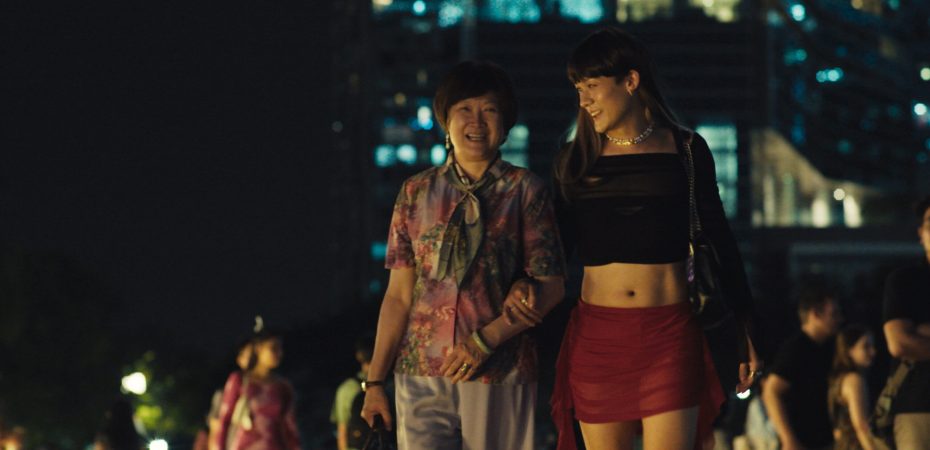
Written and directed by Ong Kuo Sin, Jia-hao is a sassy Singaporean drag queen who, having experienced a tough childhood, barely sees his family. But when his father passes away, Jia-hao reluctantly returns home to help his brother care for their mother, Ju-hua, who has recently been diagnosed with dementia. Starring: Richie Koh, Hong Huifang, Johnny Lu, Charlie Goh and Cheryl Chou.
Trying to create a balance between the glamorous, fierce, extroverted drag queen personality and sense of humour, with a grounded, tender family drama is no easy task, so Ong Kuo Sin deserves a great deal of credit for what he’s created with A Good Child. Its tone is entirely unique, there’s a touch of darkness to it, it’s a little bit twisted, and at times silly, but it’s also earnest, genuine and unexpectedly moving. It’s a highly original combination and one that is a real pleasure to watch unfold.
Ong Kuo Sin creates an atmosphere filled with a big energy and it certainly captures that unstoppable force of nature which you find in drag queens. He employs a great mix of styles to show the different sides to the story. When Jia-hao (Richie Koh) is on stage, there’s a vivacious colour, the costumes and makeup are really excellent work, and it has a hugely theatrical nature. Whereas in the scenes of just the family, things tone down and have a grounded touch and an earthy palette. That balance serves the story perfectly and is well supported by the cinematography from Yean Loon Tan with a greatly consistent, high quality, and the humble score from Christine Sham.
However, the heart of A Good Child is undeniably rooted in the performances. Richie Koh throws everything he has and more at Jia-hao. Koh perfectly taps into that idea of how people quickly dismiss those who have a tendency for melodramatics, sassiness and refuse to quiet their personalities to satisfy others. Portraying all of that vivacity and spirit but also translating it into something vulnerable, tender and brave. All throughout the film, he slowly peels back the layers to Jia-hao so that viewers can gradually see who he really is behind the performance, makeup and protective walls they’ve built for themselves. It’s a fantastic performance and one that only improves when he’s opposite Hong Huifang as Jia-hao’s mother Ju-hua.
The two of them together are incredible, the way that their relationship evolves throughout A Good Child with all of its ups and downs is genuinely touching to watch. Hong Huifang’s character may be struggling with dementia but that doesn’t limit her performance whatsoever. The level of emotion and complexity that Hong Huifang is able to bring is deeply affecting. Then you add Johnny Lu’s David into the equation, and it rounds out the trio with beautifully sweet, compassionate and unselfish qualities. The way that those performances and the film on the whole evoke your emotions feels reminiscent of Lulu Wang’s The Farewell.
It’s difficult to describe A Good Child in a way that truly does it justice because Ong Kuo Sin has created something unique. It may have familiar themes but the way that the film explores them is entirely original, it’s playful yet poignant, melodramatic yet humble, it’s relatable and real. Using that comedic vein, it’s easy for it to take you by surprise how hard it can hit emotionally but it is terrifically moving. The balance of drama and comedy is impressive, and it features some fantastic performances, Richie Koh and Hong Huifang give such complex, charming and tender portrayals. It’s funny, touching, endearing and is crafted in such a loving manner.

