
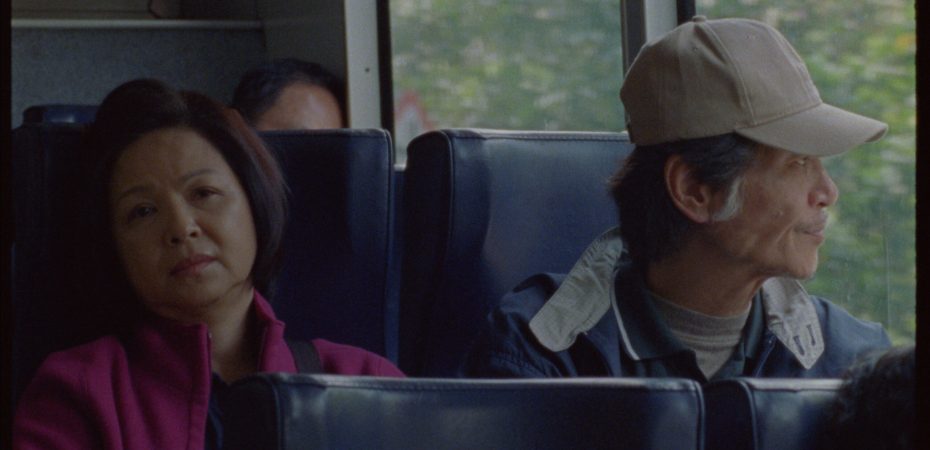
Directed by Tzu-Hui Peng and Ping-Wen Wang, and written by Yi-Hsun Yu, an old man with a limp, Khim-Hok, has depended on his wife over the years. They live in an old house on the urban fringe of Taipei. After his wife suddenly passes away, Khim-Hok puts her into an old freezer as he faces a new life without her. Starring: Jieh-Wen King, Yang Kuei-Mei, Lan Wei-Hua, Joe Shu-Wei Chang, Chiasui Chen and Jack Kao.
What’s fascinating about A Journey in Spring is how reading or not reading the synopsis before viewing could create quite a different experience. Not knowing that Khim-Hok’s (Jieh-Wen King) wife Keoh Siu-Tuan (Yang Kuei-Mei) is going to die could make that moment pack a bigger punch. However, knowing that it’s coming, and since it does not come quickly, it makes you on edge waiting for it, wondering at each instance of her daily life that she might pass away. It’s unusual to make it such a key point for the plot but have it happen once a good chunk of the film has passed. It’s also a clever choice as it gives that anticipation as well as plenty of time to establish their relationship and see a few different sides.
The main side being that this is your classic marriage of a husband who puts in the minimal effort, gives little to no affection, outwardly resents his wife and completely underestimates how she betters his life, until she’s gone. It’s entirely realistic and there are countless marriages out there much the same but that doesn’t make it any less difficult to watch. It’s a slow, pensive story which is built within this entirely earnest style from Tzu-Hui Peng and Ping-Wen Wang. Along with cinematographers Yosuke Kato and Wai Kin Sou, they create a nostalgic air which perfectly fits the reflective nature of this story.
There’s a softened, warm glow to the aesthetic, it provides an interesting contrast to the incredibly sorrowful story. It also allows the filmmakers to make the most of the landscape, to mix those intimate, everyday moments with some wonderful, natural locations which add a good boost of colour. Going back to the progression making unusual choices, that continues to work well throughout A Journey in Spring. It doesn’t go exactly as you’d expect, and it doesn’t just hand you everything, it forges its own path in a sombre manner. It’s not often you find a film that keeps its plot really quite simple but is filled with complexity and shattering emotion.
Keeping it simple also goes for King Jieh-Wen’s performance, it’s quintessentially obstinate, grumpy and stoic. Yet, after his character’s wife passes, there’s all sort of layers that begin to emerge without him ever really having to say anything. He does such a fantastic job of communicating the absolute brokenness of his character and how he’s adrift through his body language and movements. Then when the son arrives, the situation gets even more complicated, again while saying very little but it’s certainly to its advantage.
Lan Wei-Hua as the son brings basically the opposite of his father, openly emotional and caring but at the same time you can see some of the stubbornness reflected in his relationship with his own partner. It was an unavoidable inevitability that Yang Kuei-Mei’s performance was going to be relatively short, but it is excellent. It’s really a shame not to see more from her because she builds a strong personality, relatability and charm.
A Journey in Spring exists within a shroud of sadness that intensifies as time goes on. It finds so much emotion in its quiet moments, it’s humble and patient while also being heartbreaking and full of regret. It has a gradual pacing which was a great choice to embrace its difficulties, the arguments and emotional struggles. There’s a great cast at work and the directorial choices all really expand the atmosphere so that the film can say so much more, and they chose some terrific locations.

