
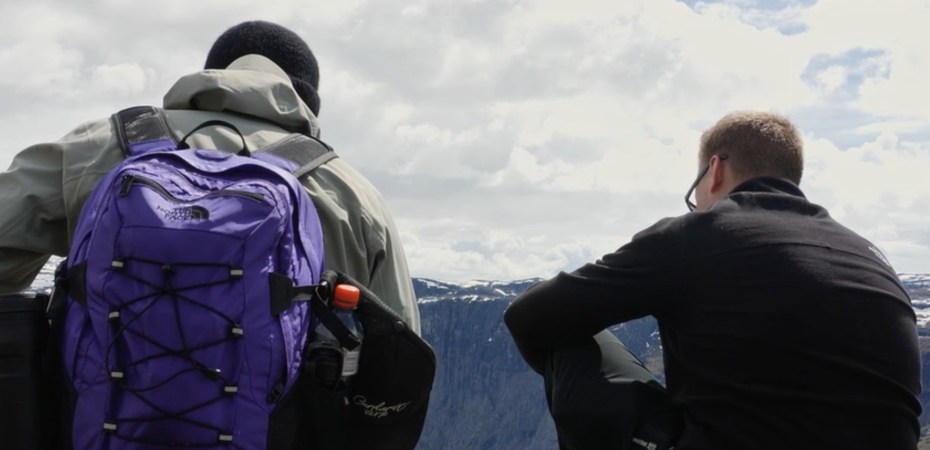
Directed by Morgan Staveley, co-directed by Kirk Milner, following the loss of his grandfather, filmmaker Morgan Staveley travels to Norway on a personal journey to confront grief, fear and the search for happiness. From the heights of Trolltunga to the exhilaration of a skydive, the journey challenges him to push beyond his comfort zone and discover what it means to keep moving forward.
Many documentaries exploring the loss of loved ones and grief often spend most of their time recounting their lives, their relationships and the topics which may have weighed upon them or contributed to that loss, but Morgan Staveley takes things in a very different direction. Choosing not to focus on the loss, but instead on how to move forward in a way which celebrates and respects his late grandfather. Ultimately, creating a portrayal of what it means to push yourself to positive experiences and to rediscover happiness in the face of grief, rather than solely being crushed by it.
That in itself is an extremely difficult thing, loss is a heavy weight so to find the energy and motivation to take on new challenges during that trying time, is an incredibly admirable and impressive challenge for Morgan Staveley to take on. Choosing Norway for the location of that challenge of course leads to some terrific visuals. The aesthetic value of those locations can’t be understated; it’s a plethora of natural beauty which makes for excellent footage and boosts the atmosphere of Learning The Art of Happiness.
Considering that Learning The Art of Happiness marks the directorial debut of Morgan Staveley, he doesn’t choose to simply follow the traditional documentary playbook, there’s a lot of his own personality and style reflected in the choices of the film. One that particularly stands out is the way that the style feels strongly like it’s coming from an action cinema fan. The score and shot choices can often reflect that kind of intensity, being highly dramatic, and occasionally a little too much so. The score in particular can be quite drastic and not entirely suited to the otherwise intimate tone of the film, with the sound mix needing to favour the narration more for that emotional connection, and tone down the score.
In a similar vein, the way that Staveley opens the film has an interesting dramatic touch, it’s a thoughtful recreation or interpretation of the experience of grief. It nicely touches upon how it can feel like moving through a dense fog, forever in a haze. However, when Learning The Art of Happiness then moves to the scenes in Norway, it’s a somewhat jarring transition, the two styles don’t naturally complement one another, even though they do both hold value.
Additionally, while it is a great concept to focus on that theme of trying to transform the experience of grief into something life-affirming and finding happiness again, it would have also been nice to spend a little time exploring the relationship Staveley had with his grandfather. To be able to have that context while experiencing Learning The Art of Happiness could have crafted a slightly deeper connection with the audience. Although arguably that does ask even more of the filmmaker, especially during a sensitive time, so the choice to not spend much time on it and simply use home-videos and photos is entirely understandable.
Learning The Art of Happiness is original and heartfelt, it comes from a very loving, respectful place which you can definitely sense in the documentary. Credit has to go to Morgan Staveley for the creative choices he makes, to not simply follow the usual formula and take some swings with his debut, even if not every choice will work for everyone, you can see the meaningful intentions behind them. There’s some excellent footage, strong narration, and it does very well to capture the idea of living your life to the fullest in memory and celebration of those you have lost, in order to move forward.

