
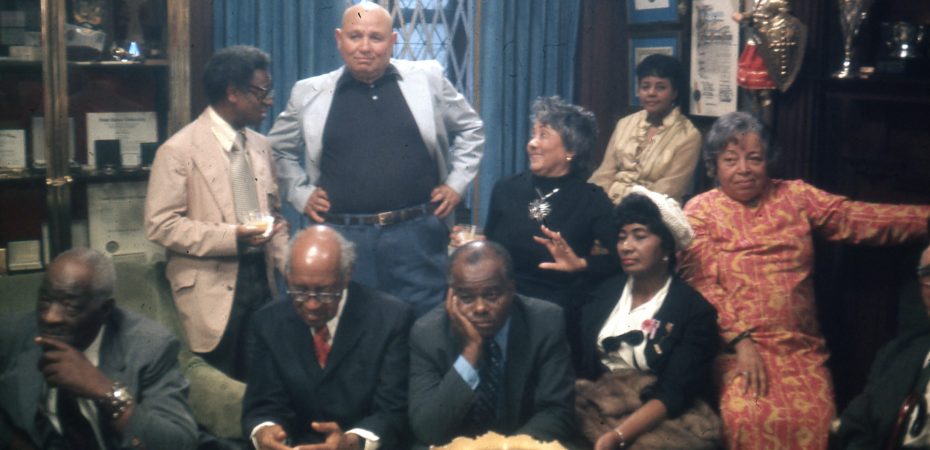
Directed by William Greaves and David Greaves, a decade after his death, genre-defying filmmaker William Greaves has one last trick up his sleeve with what he considered the most important event he captured on film: a 1972 party he engineered with the living luminaries of the Harlem Renaissance. Featuring: Aaron Douglas, Richard Bruce Nugent, Ernest Crichlow, Eubie Blake, Leigh Whipper, Arna Bontemps, William Greaves, James Van Der Zee, Ida Mae Cullen, Noble Sissle and Romare Bearden.
As soon as you enter Once Upon a Time in Harlem, you’re greeted with its utterly enticing, erudite, gracious, passionate presence. It’s the perfect taste of what’s to come because there is so much effervescent, enrapturing personality to be found within this documentary. Part of which undoubtedly being the phenomenal group of artists which were brought together for this party, but the directorial style also has a lot to contribute to that personality.
The shot choices by Greaves, the movement, and the use of split screen all have so much to say, on top of the in depth conversation unravelling within that footage. His direction adds a sense of humour, a sincere admiration and reflects the liveliness and commitment of this group. All of his choices serve to enhance and appreciate the discussion being captured by his lens, to portray the talent of his subjects as well as their impact on culture and history.
That is the real heart of Once Upon a Time in Harlem, capturing through their discussion how their art, in its many different forms, began a clear path to progress. How they carved a way for the many artists which came after them, some of which stood in that room with them. It’s fascinating to watch them recount how the Harlem Renaissance took hold, especially as it’s not all smooth sailing, they don’t agree on everything, they challenge one another. Particularly when it comes to not overlooking the contribution of women within that movement.
It is utterly satisfying to watch Once Upon a Time in Harlem craft such a remarkable time capsule of the era. The cinematography beautifully highlights the superb fashion and style, both of the subjects and of the home which hosts their riveting party. The tone is charming, the documentary moves with a natural, serene flow which is then satisfyingly charged with the unwavering passion of the subjects. It’s an outstanding celebration of the engineers of the Harlem Renaissance, and their seminal work. It’s graceful, composed, and filled with intelligence and talent.

