
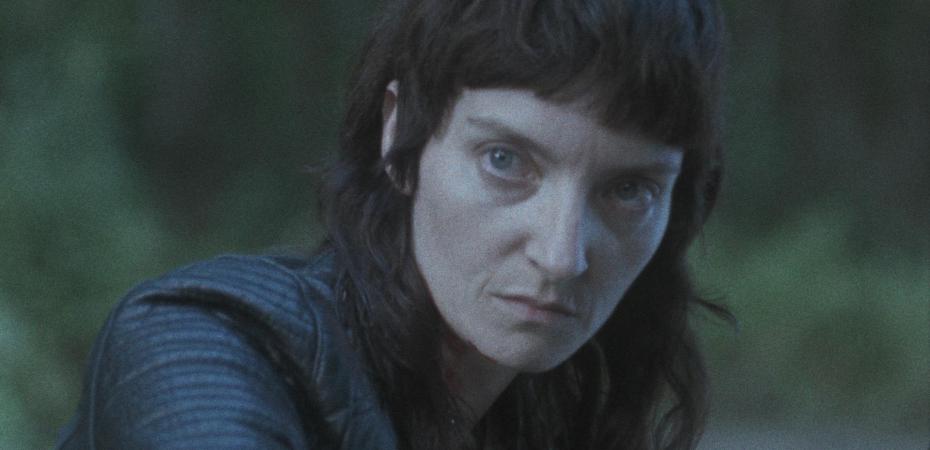
Written and directed by Denis Côté, Mira is a solitary woman of few words. She travels the roads meeting desperate people with whom she seems to have forged strange death pacts. With no apparent destination, she meets Madeleine and Ludo, two free-spirited hedonists living deep in the forest. Taking a break from her missions and unsettled by a sudden encounter with an excessive and intriguing young man, she uses this stopover to question her wandering life and reassess her dark agreements. Starring: Larissa Corriveau, Philippe Rebbot, Xavier Bergeron, Gabrielle Lazure, Pierrette Robitaille and Amélie Dallaire.
When you think of films exploring what it means to live, and what life is worth, you probably wouldn’t immediately imagine one of a woman whose job it is to facilitate euthanasia, but as Denis Côté proves with Nobody’s Violence, it does actually work. That’s the charm of this film, its incredibly strange, roundabout way of understanding the value of life by spending so much time with death.
That immediate observer perspective Côté chooses to open the film with to add these curious, enigmatic, obscured notes works very well to quickly tap into your intrigue. Something which is then expanded much further by the performance from Larissa Corriveau who manages to instil so much in Mira, while saying very little. The intensity which Corriveau brings is one of Nobody’s Violence’s biggest strengths, it’s captivating and almost inscrutable but she allows the cracks to appear as time goes on so we can see who Mira truly is. She’s fascinating to watch and could easily lead this film with very little other characters’ involvement.
The cinematography from Vincent Biron has a purposeful grain to it, it stands out and creates a less simple aesthetic while simultaneously feeling like it’s taking things back to the 1970s. It’s distinctive and it matches the rich air of sadness and melancholy of Nobody’s Violence very well. There’s a sporadic quality to the way that the film moves, but it manages to keep that tone consistent. The atmosphere and visual are strong work throughout.
The weakness of Nobody’s Violence comes in the form of Mira’s sojourn with Madeleine (Amélie Dallaire) and Ludo (Philippe Rebbot), it simply doesn’t have much at all to add to the film. We’re handed this fascinating woman in Mira who is effortless to watch as it’s hard to have any idea what she’s really made of, then her story is pushed aside in favour of a creepy, cult-leader type figure in Ludo and it’s frustrating waiting for things to get back on course. Unfortunately, the film just isn’t the same after that point, which is a shame as there is a meaningful moment towards the end, but the impact is dulled by the cloud of Ludo hanging over it.
Nobody’s Violence has a very interesting concept, and a terrific lead character in Mira, but it gets distracted along the way and falls short of its potential. It’s shot well, has a strongly individual personality, and is anchored by a superb performance from Larissa Corriveau. It holds an intriguing, complicated presence and there’s a lot of interesting questions at work within its story, but it strays into an indulgent tangent which completely throws it off course, and it never really recovers.

