
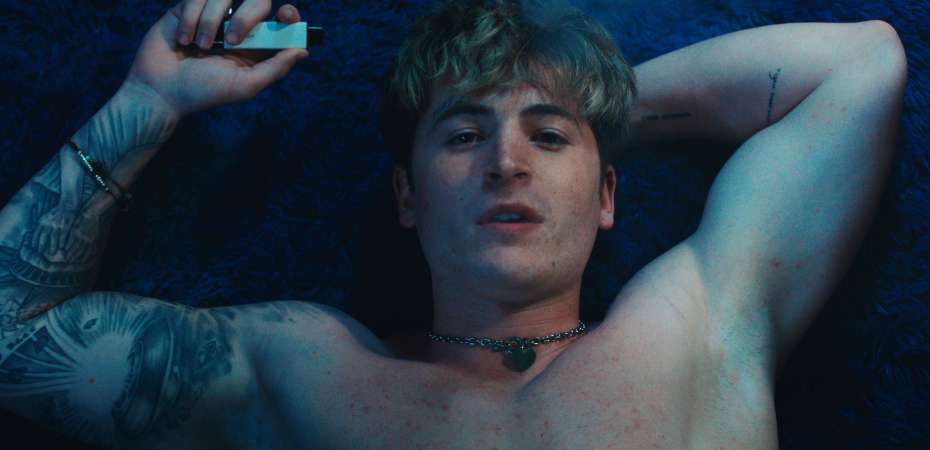
Written and directed by Elliot Tuttle, drawn by the promise of easy money and anonymous sex, queer camboy Aaron Eagle is shocked to discover a personal connection with the mysterious stranger who has paid for his company. Over the course of one night, the two men engage in a war of words and emotions as they wrestle with the impact of a tainted and shared past. Starring: Reed Birney and Kieron Moore.
In this day and age, providing viewers with a truly confronting experience, one that leaves them unsure immediately what to do with it, or even how to unpack it, is an exceptional thing. Being able to walk out of a film and think: What did I just watch? Or struggle to piece together the questions it’s asking, let alone even attempt to string together answers is, for any person who spends a good chunk of time watching films, a genuinely rare occurrence. That’s what Elliot Tuttle gives the audience with Blue Film.
There’s an inescapably powerful quality to its presence, the way that it’s able to create this effortlessly strong hold on you. Tuttle employs intensity right from the second Blue Film opens, it’s a very particular kind of aggression, it’s in your face and fully embraces the erotic persona of the film, yet it’s not sleazy or vapid in a traditional sense. That’s because there’s a considerably controlled nature to it, one that is genuinely fascinating. In no small part because of how it is so intrinsically caught up in desire and yet never finds itself at the mercy of desire. Tuttle makes it so that each sexually driven scene is another psychological layer to unwrap, it both is, and isn’t, about physicality and attraction. It’s a distinctly unusual kind of intimacy.
The topics of Blue Film are inherently controversial, so to have the characters discuss them so out in the open takes you aback. Part of why it can be difficult to unpack is that initial shock, the calmness of the characters when discussing such a wickedness is discombobulating. When you’re so used to these topics being approached with outrage and disgust, you’re left unmoored by how Tuttle instead makes it a cavalier, if intense, conversation. The writing is excellent from start to finish, and of course you wouldn’t be able to appreciate that without the stellar performances from Reed Birney and Kieron Moore.
Both Birney and Moore create unique portrayals, there’s familiar qualities to these characters, but they are entirely their own. It’s hard to quantify the performance from Birney because it is delivered in such a polite way, he gives Hank this typically ‘nice’, reserved, quality which is so well juxtaposed with the themes of his character, that it’s strangely disarming. While Moore gives us a performance of bravado and overt prowess which attempts to hide the broken child inside, who is revealed more as time goes on. Both of them create this bizarre form of vulnerability, and it provokes this complex question of whether being actively aware of your own toxic, wicked qualities, makes them less depraved?
Blue Film is provocative, original and twistedly fascinating. The intensity which Elliot Tuttle creates with that single location setup is exceptional, and even more so that he’s able to keep that going consistently from start to finish, and then that’s increasingly impressive when you consider that this is Tuttle’s debut feature, which is almost hard to believe. Reed Birney and Kieron Moore give undoubtedly two of the best performances of 2026, which are best watched rather than described as it would be almost impossible to do them true justice. The whole film is put together with such a skilful level of control that it’s hard to look away, even in its most shocking moments, and the clever extra touch of home-movie clips is particularly chilling. Definitely a film that is best to go into knowing as little as possible for the full impact.

