
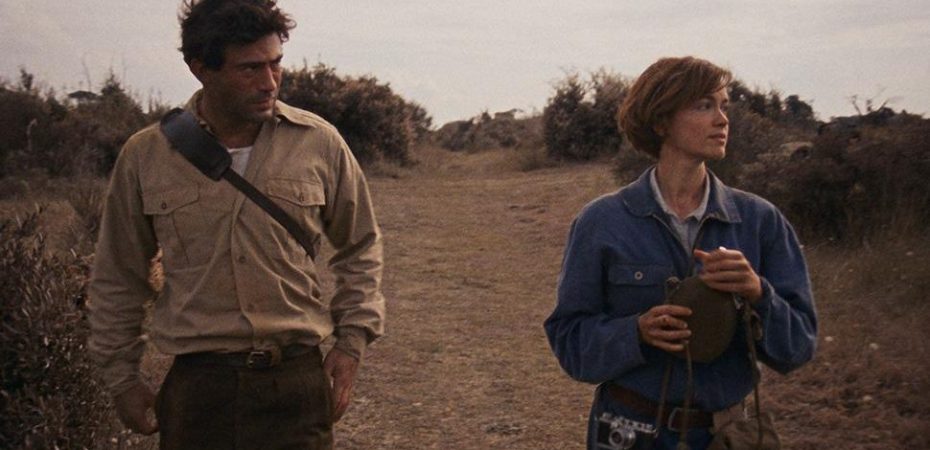
Written and directed by Alina Marazzi, co-written by Valia Santella, based on the novel by Helena Janeczek. Paris, July 14, 1937. Gerda Taro spends her final day before returning to the Spanish front with Robert Capa and the friends with whom she fled Nazi Germany. Weaving together her political activism in Leipzig, her years in exile in Paris, her encounter with Capa, her discovery of photography and her growing determination to use her Leica as a tool of resistance and freedom. Starring: Emilia Schüle, Aaron Altaras, Lucas Englander, Luna Wedler, Sebastian Schneider, Thomas Schubert and Idan Weiss.
Alina Marazzi and cinematographer Manuel Alberto Claro, make a great first impression with The Girl with the Leica, delving straight into the era with an aesthetic which is warm, classic and has an excellent grain. Something which is then complemented by the movement to Marazzi’s direction which holds a smooth, suave flow to try and match the fervent energy of its leading lady Gerda Taro, played by Emilia Schüle. The visual is consistent all throughout the film, it commits to that era feel and it’s satisfying to watch, but sadly it’s let down by the story.
The material itself is good but how it plays out in The Girl with the Leica is like a whirlwind tour through an artist’s perspective of the war. It never settles down, it doesn’t give you time to get to know the characters, its intentions are entirely unclear. Particularly because they have Taro spending very little time using her camera, unlike what the title would suggest. She doesn’t truly feel like a photographer, other than demonstrating her keen eye, it only effectively captures the rebel side of her.
That’s really the key issue with The Girl with the Leica, it’s rushing so much to get through years of moments, that it never does true justice to any of them. Marazzi also tends to employ a great deal of archive footage and imagery which becomes too much. It wanders into the territory of documentary, rather than biography and stalls the momentum even further. It struggles to build a genuine connection, to capture the emotional depth beneath these issues. Although to its credit, the style does do a good job of capturing the personalities.
As does the performance from Emilia Schüle, it’s vivacious, passionate and committed. The qualities which you’d want to portray a rebellious, independent, strong-willed woman are undoubtedly brought to the table by Schüle. She’s also got a great supporting cast behind her who similarly bring an academic, activist feel to The Girl with the Leica. There’s a great deal of potential with this ensemble, but the story doesn’t give them the space to fulfil that.
The Girl with the Leica is shot well and has terrific cinematography but it ultimately feels disconnected. It captures the spirit of the characters, but it’s never clear if Alina Marazzi and Valia Santella wanted to tell a story of romance, one of Gerda Taro’s passion and heroism, or one of the importance of journalism and photography in the war, it’s a mix of all those things and that indecisiveness is its Achilles’ heel. The elements are there but it’s in too much of a rush, and it spends too much time flitting between the drama and the real world footage and images. Unfortunately, the result being that it lacks the emotional depth or power to really do justice to this story.

