
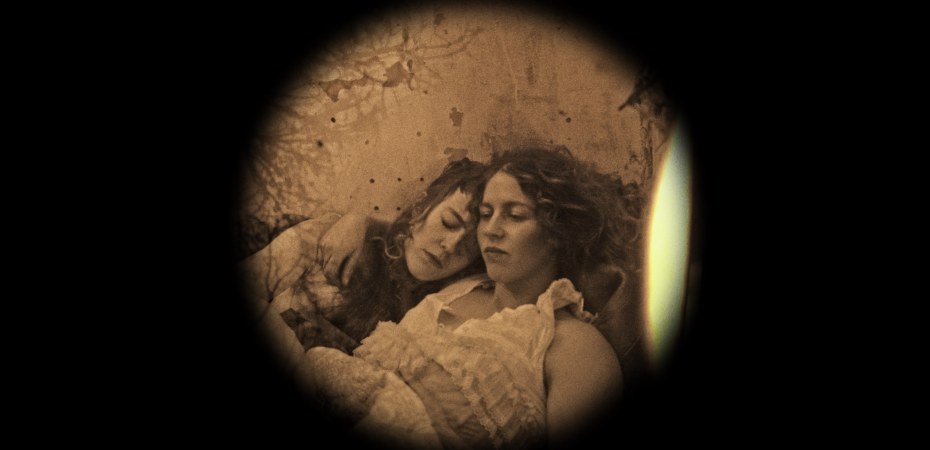
Directed by Joseph Archer and written by Cathy Wippell, in 1888 London, an amateur inventor uses his new moving image machine to document an all-female ghost-hunting society investigating the Jack the Ripper murders, which they believe are committed by a supernatural monster. Starring: Cathy Wippell, Hazel Rogers, Lydia Helen, Nadia Lamin, Rosie-Bella Johnson and Tom Stourton.
One of the elements which stands out strongly with Snapshot is that it manages to build this strongly observational, voyeur-esque style without subverting to the male gaze. Especially when considering the film does touch upon erotic themes at times, and several of the characters are women working in the oldest profession there is, yet Joseph Archer impressively manages to actually still make the film feel like it’s being told through these women. It may seem like something so simple, but it’s vitally important, and the film would not work if it fell into that desperately frustrating, dated perspective.
Especially because perspective is something so ingrained in the story of Snapshot. The audience are being given the film directly through one person’s viewpoint, Tom Stourton’s Tamworth. That opens up a lot of questions in itself, and controls how we’re given the information of this story. A vital part of how we learn new information in today’s world is knowing when to question the narrative, and to draw your own conclusions, and not simply trust what’s given to you, so how Cathy Wippell threads that into the story of Snapshot is very well done.
It’s one of several ways in which Snapshot is a great blend of past and present, it’s strongly committed to recreating that era, while using it to explore modern themes. It works surprisingly well, and on the surface, it taps directly into the style of entertainment of the era. It has that focus on theatricality, there’s a touch of tongue-in-cheek, and it doesn’t take itself too seriously. While underneath that it opens up an interesting conversation, as well as having that lingering veil of darkness and foreboding which sits quietly growing in the background.
While the supernatural element and ghost-hunting society could have been more strongly weaved into the story, to lean a touch more into the horror side of things, it does work well enough without it. It moves confidently, it’s entertaining, and it’s really enjoyable to see a period piece set in such a severely laced up time, where the women are straight talking and unapologetic. The writing subverts your expectations, it turns the usual affair on its head, which is refreshing. It can be a little bit slow in the middle and potentially could have used that time to expand the finale a tad more, but it’s never too slow.
Another key part of recreating the era is the performances, and they don’t disappoint. Much like the tone they do a terrific job of capturing the style of entertainment of the time, while also making them feel natural, which the whole ensemble deserves a great deal of credit for. While Snapshot does centre itself around a few key characters, it definitely feels like an ensemble piece, everyone gets involved, which adds a touch of chaos that complements the film well.
However, it’s the women who are really the heart of Snapshot, Cathy Wippell, Hazel Rogers, Lydia Helen, Nadia Lamin and Rosie-Bella Johnson all bring such personality and variety to the table. They’re women with a lot in common but also very different from one another. Cathy Wippell’s Minnie provides a catalyst of sorts, a woman who finds herself caught between two worlds, drawn to a more exciting life. She has a naivety but also a determination, which is an interesting balance. Helen gives us a fervent, strident persona which is charming in a spiky way. Rogers adds in a note of vulnerability, while Lamin brings a bravado and confidence, and Johnson a heaping of youth.
Snapshot chooses an unusual style and truly commits to it with the pinhole perspective, and it works really well. They do a wonderful job of creating the feel of the era, it’s a terrific concept and it’s executed with personality and mystery. The blend of genres was another great choice, it’s able to exist within the worlds of crime, horror and mystery in a fluid fashion. The direction is entertaining, the writing is unexpected, there’s a great ensemble at work, and it’s a highly enjoyable tale of obsession, perspective, fear and murder. It’s original, captivating and a strong debut feature from Joseph Archer.

