
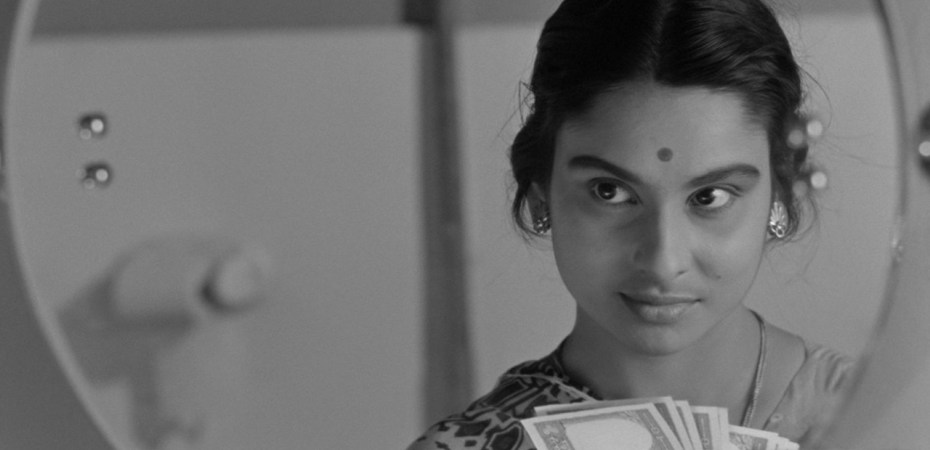
Written and directed by Satyajit Ray, Arati takes a job as a door-to-door saleswoman in Calcutta’s wealthy neighbourhoods, in defiance of her traditionally-minded husband, Subrata, and his live-in parents. Emulating her Anglo-Indian friend Edith, who speaks equal to the men she encounters on the job, Arati quickly becomes her firm’s top salesperson. When Subrata loses his job, the power dynamic begins to shift. Starring: Madhabi Mukherjee, Anil Chatterjee, Haren Chatterjee, Haradhan Bandopadhyay, Vicky Redwood, Jaya Bachchan, Sefalika Devi and Prasenjit Sarkar.
One of the most surprising elements of The Big City, considering that it was made in the 1960s in a very traditional society, is that it actually underplays its hand with the misogyny, racism, and prejudice. It’s a refreshing change of pace to see a film of that era let those themes come through more naturally, not force the dialogue or add an aggression to it. Instead, Satyajit Ray creates something that feels akin to the work of Yasujirō Ozu or Frank Capra. It’s wholesome, humble and quietly moving.
The story says a lot even when it says quite little, with a few looks here and there easily spelling out the fractures appearing in Arati’s (Madhabi Mukherjee) relationship with her husband (Anil Chatterjee) or the way people look down upon Edith’s heritage (Vicky Redwood). The writing manages to instil a feel of naivety to reflect Arati’s lack of experience, but never makes her feel meek. How she evolves as the story progresses comments on every other aspect of The Big City. It’s slow-burning story but one with a big heart and great societal commentary.
Madhabi Mukherjee leads The Big City with a light touch, she’s graceful, quiet and thoughtful as Arati. One of the most enjoyable elements of the film is watching her come to understand her power and the meaning of freedom and choice. Especially in how she views injustice and the treatment of others. Everyone else, particularly Anil Chatterjee and his character’s exploration of male fragility and traditional masculinity, has plenty to add but it’s Mukherjee who steals the show. It’s another aspect of The Big City which is a pleasant surprise, seeing as how finding a female protagonist, one that was charming and level-headed like Arati, was fairly uncommon for the era.
The Big City is pretty much exactly what you could want out of a 1960s family drama, it’s wholesome, there’s a good dose of tension and conflict, and it all makes up a journey of self-discovery, empathy and loyalty. The restoration work is wonderful, to be able to have that level of detail adds such a satisfying grain to an already enjoyable aesthetic. Satyajit Ray’s direction moves with patience, it’s considerate and quiet but also charged with commentary. The film is led by a fantastic performance from Madhabi Mukherjee and there’s a terrific ensemble behind her. To find a 1960s drama touching upon the hugely relevant themes of the era, without the need to ramp things up into endless arguments and nastiness, is genuinely delightful. Ray deftly handles the topics of power balances in marriage, inequality and gender roles.

