
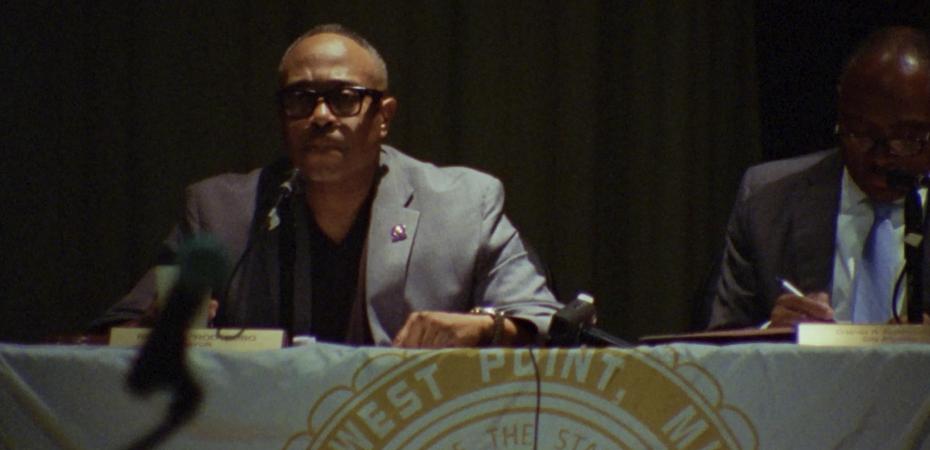
Directed by Kevin Jerome Everson, chaired by the city’s mayor, Rodick Bobo, a relative of the filmmaker’s, motions are moved, seconded and voted on. Pay rises for city employees, permits for food trucks, and other matters of municipal governance are discussed in view of the camera’s fixed frame. Against a wider backdrop of decrepit democratic systems in the country, a portrait of an attempt at earnest, accountable politics in the USA emerges.
The idea behind Clay is a truly excellent one, to give viewers an experience of truly efficient and effective government work. To be able to see politicians actively working to improve their city, to make sure their employees are valued and paid according, and that they’re making the city financially secure. It’s something which is so rarely seen, especially in today’s landscape in the US where politics have become a parody of themselves and nothing is straightforward nor transparent.
Visually, Clay has a 1970s feel, despite being shot in 2025, which adds a lot of character to the proceedings. There’s a nostalgic texture which nicely matches the intentions of Kevin Jerome Everson to take things back to a more wholesome, honest time. Rodick Bobo makes for a terrific choice as a subject, he speaks with such grace, consideration yet efficiency, it’s surprisingly enjoyable to watch. It’s especially great to see him take care to acknowledge people and their concerns.
However, Everson chose an intensely minimal style for Clay. It’s one camera, a fixed shot and one mic. What that means is that the dialogue for a lot of the other participants in the meeting is not heard, and it can come in and out. It also means that there’s a number of occasions where they stand directly in front of the camera, blocking the view of Bobo. There is a certain charm to that, to reflect the earnest intentions of the documentary but it feels like it’s limiting itself too much.
There’s some great material to be found within such everyday matters. It would have been interesting to get more context on the city itself, how and when Bobo became Mayor. What his platform was, and digging into the improvements that he’s made that he briefly touches upon. There was room to take this and run with it, to turn it into something more accessible and in depth, in order for it to reach its full potential.
Clay achieves what it set out to do, creating a humble, simple portrait of what positive political action looks like. It’s interesting and Kevin Jerome Everson chose a wonderful subject in Rodick Bobo, but it takes that minimal style too far. Adding a little context and development to really round out the documentary could have taken this to a more impactful place. Although, Everson had fantastic intentions and there is a lot more being said than just the motions of the meeting.

