
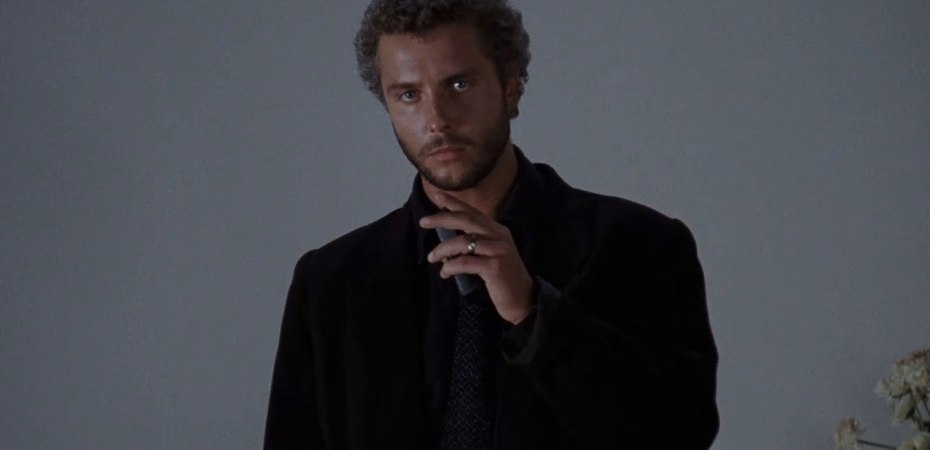
Written and directed by Michael Mann, FBI Agent Will Graham, who retired after catching Hannibal Lecktor, returns to duty to engage in a risky cat-and-mouse game with Lecktor to capture a new killer. Starring: William L. Petersen, Tom Noonan, Dennis Farina, Brian Cox, Kim Greist, Joan Allen and Stephen Lang.
While saying a film is very of the 1980s can be both a terrible and a great thing, Manhunter: The Final Cut definitely lands in the positive. Every element of Michael Mann’s style here is so reminiscent of that era, and he crafts an enviable broodiness that’s exceptionally strong. Part of that is how Mann crafts the film to not simply focus on the need to catch the killer, but really make use of Thomas Harris’ writing to bring through those layers of psychological turmoil for Will Graham (William L. Petersen).
Portraying the heavy weight which lies upon his shoulders, both to prevent further killings, and to stop himself from being lost within that dark world, adds a depth that most crime-thrillers don’t hold. It expands the atmosphere and creates a compelling presence. Having that side of the story creates an excellent balance with the actual cat-and-mouse game of seeking out a psychopath, it’s the best of both worlds and portrays how they overlap. Allowing Manhunter to build this growing intensity and fury which easily keeps you glued in.
However, without question, another aspect which locks you into Manhunter is Mann’s direction. His use of negative space and clean lines, and his understanding of colour and being able to layer the cold, calculated nature of the story into the visual is fascinating to watch at work. Especially with the terrific restoration work which makes an impact right away. Mann makes a lot of superb extra touches to elevate Manhunter, but the really extra touch was certainly employing a real, sedated tiger.
Then there’s the score from The Reds and Michel Rubini, it’s full of deep, booming notes and a great grittiness which is so satisfying. The score and choice of music is something that builds so well to really strike the hardest note in its finale, culminating in an iconic use of Iron Butterfly’s In-A-Gadda-Da-Vida. The editing (from Dov Hoenig) particularly stands out in that finale, it has a purposefully blocky quality which is such a strange choice but works so well.
Of course, there’s one other key element which brings all of that together, and that’s having William L. Petersen at the helm. He has an unusual blend of feeling unthreatening but enigmatic, he plays the hero card well but at the same time leaves you wondering what might happen if he gets pushed a little too far into that darkness he’s trying to empathise with. Making for a great lead, who then has an excellent supporting cast behind him.
Brian Cox as Hannibal Lecktor, for anyone unaware would probably sound like a wild choice today, and the way he delivers the character in a more casual manner than people are familiar with from Anthony Hopkins may also seem strange, but it’s superb. He adds in all of those dangerously clever qualities in a satisfyingly suave manner, rather than leaning into threatening notes too much.
Tom Noonan makes for a strong villain, tapping into all of those creepy, unhinged, perverted and unbalanced qualities so effortlessly. Dennis Farina could have done these roles in his sleep, it’s so familiar and he’s utterly reliable every time, adding in a note of comedy. While Joan Allen is wonderfully unexpected, her character has a complexity which is not often found in this type of character, and even more rare for the era it was made.
Manhunter: The Final Cut is a cult classic, it has a tenaciously twisted edge and a suavely gritty style. It has personality, depth, tension, suspense and that veil of sexualisation to both draw you in, and embrace the depraved nature of the story. The structure of Michael Mann’s shots, alongside Dante Spinotti’s cinematography is seductive. Every element fantastically gets to grips with those blurring lines of hero-villain, cop-killer. The superb restoration work is a perfect excuse to revisit it, because it is one that only seems to get better with age.

