
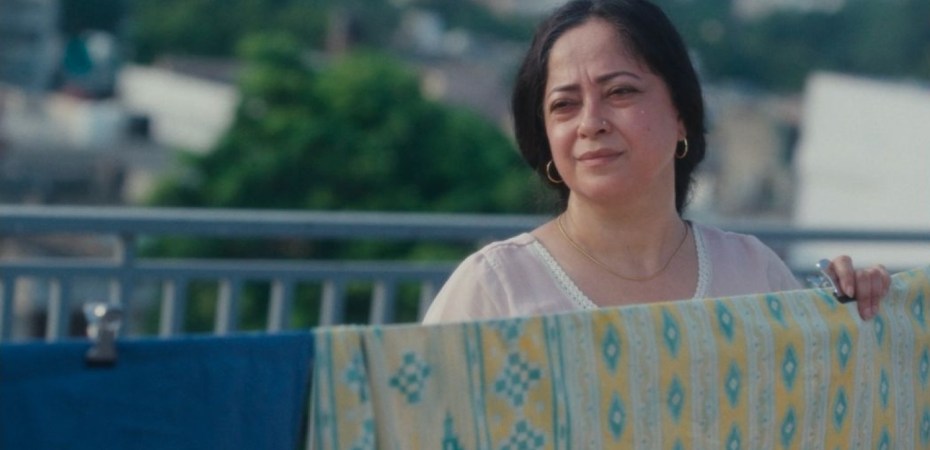
Written and directed by Aakash Chhabra, a son returns from abroad only for his mother to reveal a secret she’s been hiding all his life leading to an exploration of longing, memory, and unspoken tensions through the lens of a mother-son relationship. Starring: Lakshvir Saran and Sheeba Chaddha.
There’s a quality to how Warm Shadows opens that almost feels as though you’re about to watch a documentary, it has a very real, sincere feel to the aesthetic. That was a really great choice from cinematographer Vignesh S because it’s so well matched to the warmth, authenticity and emotional depth of the atmosphere which Aakash Chhabra builds. Also, that choice also immediately gives the short a strong presence, especially when matched with the serenity and evenness of the tone. All of that helps in turn to create the appreciative, loving air to Warm Shadows.
The entire film has a pensive quality, it spends a lot of its runtime moving in a quiet, reflective manner. There’s a surprisingly relaxed nature to the film on the whole, and that comes with advantages and disadvantages. It moves smoothly and has a compelling tone, but at the same time, it takes too long to arrive at the crux of its story. It’s playing things overly subtle, which is a shame as it has such a lovely story to tell and doesn’t give enough time for it to be explored in a satisfying way, or in a way that does true justice to its meaningful nature.
It’s also a shame as both Lakshvir Saran and Sheeba Chaddha give sincere, understated but impactful performances. That’s really part of what keeps you glued into Warm Shadows with its slower pacing, the connection between Saran and Chaddha. The unspoken respect and consideration of one another is sweet and another element which adds to the film’s endearing warmth.
Warm Shadows has a lovely story to tell, it’s shot well and it has a wonderful, emotionally driven presence but it doesn’t use its time as effectively as it could have, to reach its full potential. There’s a strongly thoughtful, reflective nature to the direction, which is well paired with the inviting aesthetic. Lakshvir Saran and Sheeba Chaddha bring such natural, warm portrayals to the table which make them easily captivating.
There’s such a fantastic, necessary conversation about the LGBTQIA+ experience in India, and looking at today versus what past generations went through, at the foundation of this short, but we only get to see that spark come alive in the ending scenes. It would have been great to see it get to that moment a bit sooner, so it could be explored further and do a little more justice to its poignant nature.

