
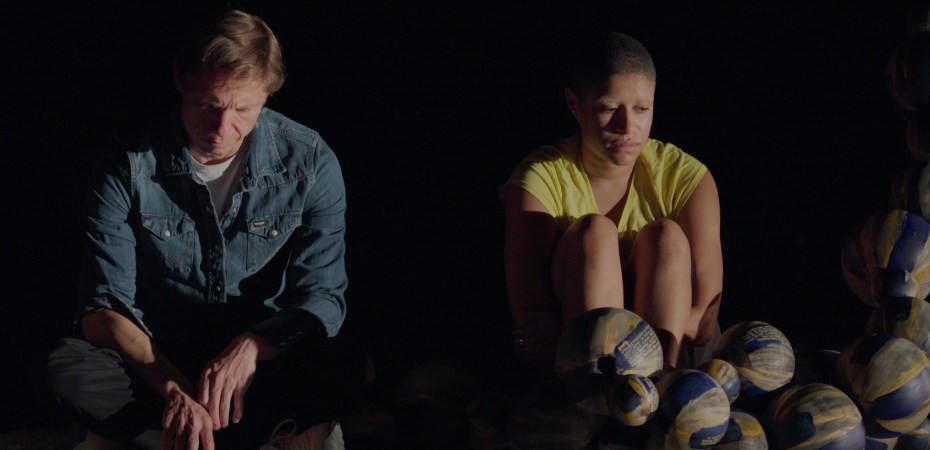
Written and directed by Kristof Bilsen, co-written by Xan Márquez Caneda, through the ritual of saying sorry, this documentary explores how apologies redefine history and what happens to us as witnesses to the act of atonement. Featuring: Musia Mwankumi and Valentijn Dhaenens.
Undeniably the act of the apology is an inherently relevant subject to today, its meaning and use have become incredibly complex in today’s society. Meaning that the concept behind The Apologist is definitely a good one, to explore what an apology really signifies in the modern world, and how much of an impact, or not, it can have. However, the perspective in which Kristof Bilsen takes to delve through this journey, doesn’t feel like it was an effective or powerful choice.
Even early on in The Apologist the style feels scattered, it struggles to ever settle in, constantly on the move and thereby lacking the cohesiveness to make a definitive impression of what it’s trying to say. Bilsen employs a lot of recitation, which lacks power. You can feel at several points that there are genuine attempts to add emotion and intimacy, but they miss the mark. There’s something to its style which comes across as cold, partially because they’re taking a more academic approach, and a lot of the film can appear more akin to the research than the finished product.
There are also a few creative choices that fall short, particularly the use of children to recite famous quotes and interpret them which feels unfortunately performative and strange. It speaks to one of The Apologist’s key issues which is a lack of self-awareness. Something that they do slightly begin to improve upon towards the end, but it comes too late. It’s particularly noticeable when it comes to Musia Mwankumi, in so many of these scenes, it’s Mwankumi’s opinion and experience which really play such a key role and yet instead of giving her that space, it goes primarily to Valentijn Dhaenens, which is disappointing.
The Apologist has a good idea, the concept is highly relevant and somewhere within this footage is a great point about apologies in the modern era, but it isn’t presented in an effective manner. The execution feels jumbled, as if we’re seeing the pieces but not the finished puzzle. Ultimately, it feels like the filmmakers ended up too close to the subject and needed to take a bigger step back to rethink the bigger picture and the perspective they were building.

