
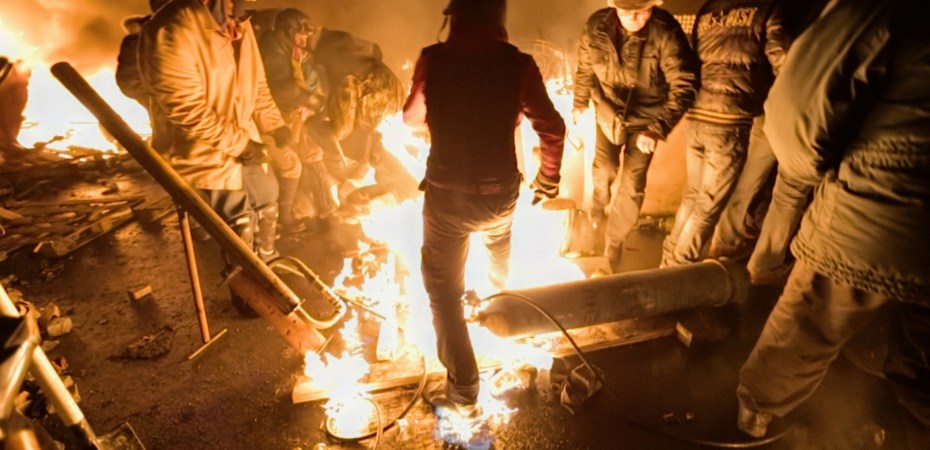
Directed by Roman Liubyi and Volodymyr Tykhyy, a spectral voice drifts through time and memory to trace the Maidan revolution and the roots of resistance in Ukraine. The voice is searching for Maksym, a friend and mentor killed in the war with Russia, and the grief of that loss propels it backwards and forwards through time.
In recent years, particularly since the beginning of the Russian invasion of Ukraine, there have been a number of documentaries exploring the Russo-Ukrainian war. Most of them have focused on the current conflict, whereas Roman Liubyi and Volodymyr Tykhyy take things back further to the root of the war. They chose to do so not in a traditional manner but instead to provide viewers with a guide to this exploration. A voice to look back at the events of the time with the knowledge of what’s happening today.
It’s a very interesting, unusual choice and it works surprisingly well. Having this narrator of sorts add such a personal, accessible, sympathetic touch, gives not just context but helps audiences connect more strongly with the footage. It is certainly poignant enough on its own but rather than making simply a grand political statement about the violence, that choice helps it to instead keep a genuine focus on the dedication, motivation, resilience and strength of the Ukrainian people. Exploring the Maidan revolution unquestionably highlights how long and how ferociously Ukraine’s citizens have been fighting for democracy.
The archival footage is cut together very well to create a natural flow to Time Machine Maidan. There are also a number of creative choices which feed into the way the documentary is cut together and ultimately, some work better than others. When they lean into that perspective of its ‘spectral voice’, it nicely pushes that personal edge and air of reflection. However, when it tries to add in animated touches to transition through the footage, they can feel too purposeful and interrupt that smooth flow.
With Time Machine Maidan, Roman Liubyi and Volodymyr Tykhyy shift the perspective, not purely by taking things back to the early days of the conflict, but by also adding such a personal touch. It feels as though the documentary comes from a sincerely thoughtful place, with deep consideration for what the young people of Ukraine, currently fighting in the war, grew up with. It helps to understand more strongly why they wanted to join the fight. It’s well cut together, it’s creative, and another timely reminder of the importance of protest in the face of brutality and authoritarian regimes.

