
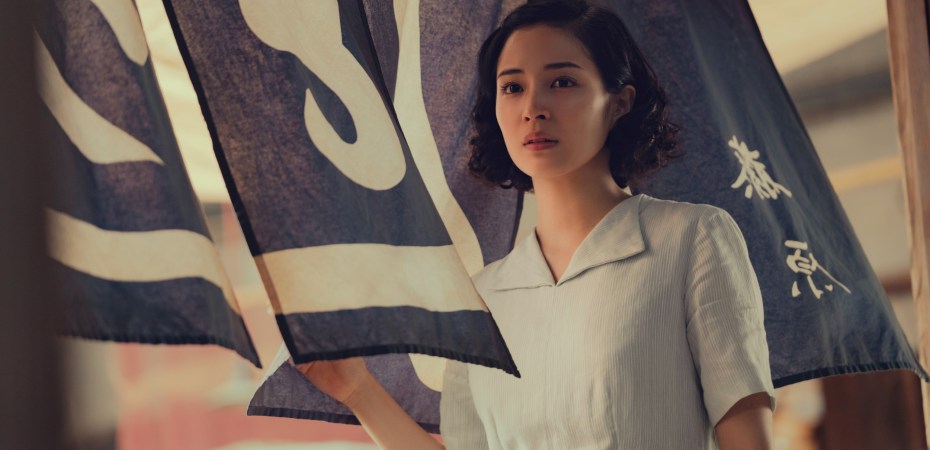
Written and directed by Kei Ishikawa, based on the novel of the same name by Kazuo Ishiguro, dual timelines explore a Japanese widow’s memories spanning post-war Nagasaki in 1950s and England during 1980s Cold War era, unravelling secrets that intertwine her past and present experiences across borders. Starring: Suzu Hirose, Fumi Nikaido, Yoh Yoshida, Camilla Aiko, Kouhei Matsushita and Tomokazu Miura.
An element which distinctly stands out with A Pale View of Hills is the cinematography in the 1950s scenes. It’s warm and filled with nostalgia, set alongside Kei Ishikawa’s direction, it almost feels like a painting come to life. It’s perfectly fitting for the era and creates this sad, pensive, quiet yet mysterious atmosphere which is enthralling. It’s just a shame that when the film then moves to 1980s Britain, it’s all fairly basic. The air and style on the whole don’t have clear individual personality, making it a stark contrast.
It’s a problem that does extend beyond the visual, when A Pale View of Hills is in the past, it has so much more to offer than when it’s in the present. The post-war Japanese setting makes for a layered backdrop to the complicated emotions of Etsuko (Suzu Hirose) and Sachiko (Fumi Nikaido). Their relationship is fascinating, it brings up so many questions, and nicely does not answer all of them, it leaves you pondering the consequences and multiple perspectives. Yet, the British scenes, reminiscing on that past and exploring grief in quite a simple manner, feel sentimental and drawn out.
The only thing that really keeps those scenes going is the performance from Yoh Yoshida. She creates a feel of open yet withholding, willing to explore that past but there are some things she wants to keep to herself. Yoshida’s performance is interesting and gives the feel of brokenness that has been plastered over, very intentionally. Suzu Hirose and Fumi Nikaido are the stars of the show with A Pale View of Hills, they’re the most compelling factor it has to offer. Their dynamic is complicated and forever changing, it creates a cryptic quality to the film. Whereas Camilla Aiko in the 1980s scenes as Nikki feels like she’s trying too hard. The character has a chip on her shoulder, and the performance is too strongly centred around that. Giving her little space to evolve or become more than an observer in this story.
Trying to adapt the work of arguably one of the greatest authors of the 21st Century is no small task. Kazuo Ishiguro’s work is complex and cleverly layered, so with attempting to translate A Pale View of Hills for the screen, Kei Ishikawa was perhaps aiming too high. This is a decent attempt, that cinematography is superb in the 1950s scenes, it’s romantic but with an edge of deceit, and Suzu Hirose and Fumi Nikaido give excellent performances. Special mention should also go to Mio Suzuki who plays Mariko with a surprisingly intricate portrayal given how young she is. As well as Tomokazu Miura as Ogata who presents a very clear example of how it can be difficult for older generations to accept or even perceive the manipulative or toxic attitudes of the past. It does still have plenty to offer, it simply can’t quite reach the heights and emotional depth of an Ishiguro tale.
 FilmCarnage.com