
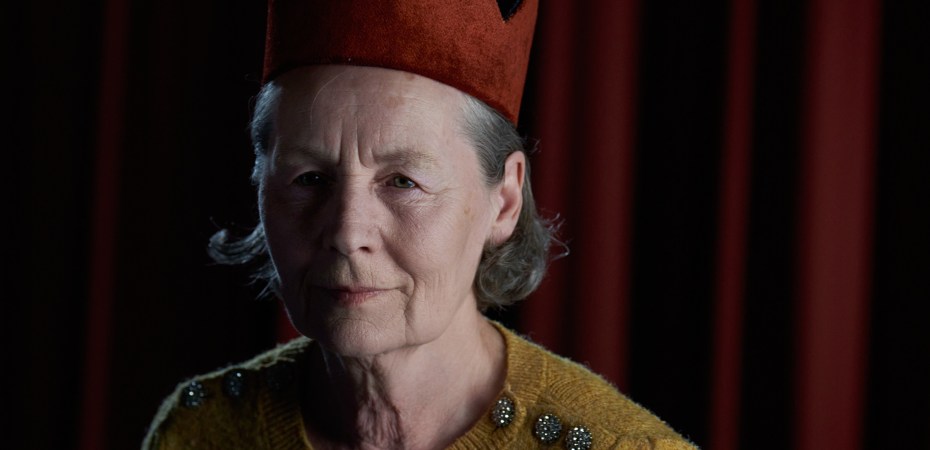
Directed by Búi Dam, who also features in the documentary, in the Faroe Islands, a family of theatre people are working on staging King Lear with the mother (Birita Mohr) in the lead role – a beloved actress who suffers from Alzheimer’s, supported by her husband (Egi Dam).
Within Birita there’s a lovely concept of helping someone with Alzheimer’s regain a little part of themselves by doing something that they loved. In this case, it’s helping a veteran actress take back to the stage with one of the most iconic plays ever written. A key element that stands out in that process is giving Birita Mohr the chance to be truly involved, not just an observer. As there is such a need to protect people with conditions like Alzheimer’s, it can mean that they become sheltered, so allowing Mohr to be right in the middle of things, but to also be able to go at her own speed, feels like a blessing.
That’s what makes Birita a lovely concept, not only does it give her a chance she never would have had otherwise in her condition, but it also celebrates her life and her achievements. As well as giving the family time to reflect upon their own situation. The tone Búi Dam instils in the documentary certainly reflects that, it’s sweet and sensitive. There’s a tender nature to it, being careful and considerate of the intensely complicated situation.
However, it feels like a lot of the documentary is not spent upon Birita Mohr, but on her son and the director, of both the play and this film, Búi Dam. There’s seemingly an attempt to make the film an exploration of the circle of life, and it doesn’t work as well. It feels like too much focus is shifted off of Mohr and turned inward. Moving away from its key subject makes it feel fairly surface level and brief, as if there was more room to explore her life and her talents, as well as everything that went into staging the play.
Birita is shot well, has very lovely intentions and a gentle, loving tone, which is nicely matched by its rich, warm aesthetic but it feels like it gets distracted along the way. It spends a lot of time following the director and his own family life, straying away from its titular subject and taking away from the focus. The scenes following Mohr and her life are the strongest that the film, and it feels like it would have benefited from following that more consistently. Although, watching the relationship between Mohr and her husband, to see their love for one another and their true commitment, is genuinely moving.
 FilmCarnage.com