
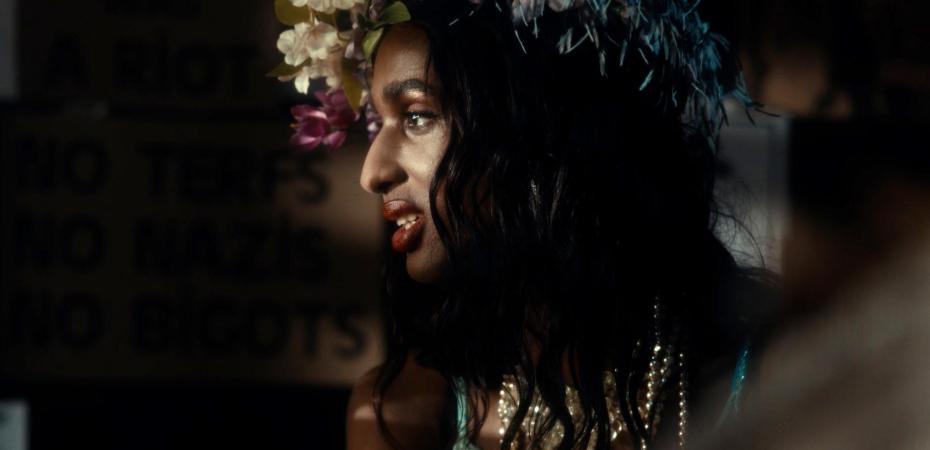
Directed by Fil Ieropoulos and written by Foivos Dousos, inspired by Arthur Rimbaud’s visionary poem Une Saison en Enfer, in which the poet’s ghost travels through history, encountering revolutionary figures and queer ‘freaks’ such as Emma Goldman, David Wojnarowicz, and Marsha P. Johnson. Starring: Flomaria Papadaki, Marlo Mortimer, Macklin Kowal, Kristof Lamp, Marissa Triantafyllidou, Alexander Voulgaris, Rea Wallden, Christos Adrianopoulos, Amani, Robert Carrithers, Foivos Dousos, Aimee Le and Eve Libertine.
Undoubtedly, there are so many things that queer cinema does so well and so uniquely, but one area where queer filmmaking can often excel is expanding what a documentary can be. Uchronia: Parallel histories of queer revolt is a fantastic example of that because there is zero playbook followed here, Fil Ieropoulos and Foivos Dousos create an intensely original interpretation of both the genre and the information at hand. They deliver it in a way that’s highly theatrical, and takes the themes of activism, outrage and artistry truly to heart.
Particularly in the earlier scenes where it feels as though you’re almost taking part in a townhall meeting for queer ideology and debate, blended with a spoken word poetry evening. It’s a fascinating blend of volatility and structure, it’s intentional yet feels fluid. In that sense, Ieropoulos creates a quietly visceral quality to Uchronia, it’s bold in very performative fashion.
The performances are such a key part of Uchronia and those featured do not disappoint. It’s lovely to begin with simply to see such a wide range of performers, and you can feel their commitment to the tone and style of the film. Some of them add a surreal note, while others feel like they’re giving a classic speech, it’s a superb mix. What’s more unexpected from those performances is how they almost bring a romantic quality to the film which pairs surprisingly well with its outrage.
However, it feels like in the latter scenes it loses that energy, it slows down somewhat and loses itself inwards in its pensive side. Particularly when it comes to exploring figures like Alan Turing or Marsha P. Johnson, as while their legacies should rightly continue to be explored, it is unavoidably, overtly familiar ground. There isn’t a great deal to add to the conversation, and it feels as though exploring lesser known queer icons instead, might have been a more compelling use of that time.
Uchronia is a unique, intensely inventive and intricately crafted hybrid-documentary. It’s bold, unexpected and poetically volatile. It does start to wane slightly in the latter half, but arguably, it is a very big, complex energy to try and sustain for ninety-seven minutes, so the filmmakers did set a challenge for themselves. Regardless, it’s a fascinating watch, exploring queer history in a new way and it creates an engaging blend of the surreal and historical.
 FilmCarnage.com