
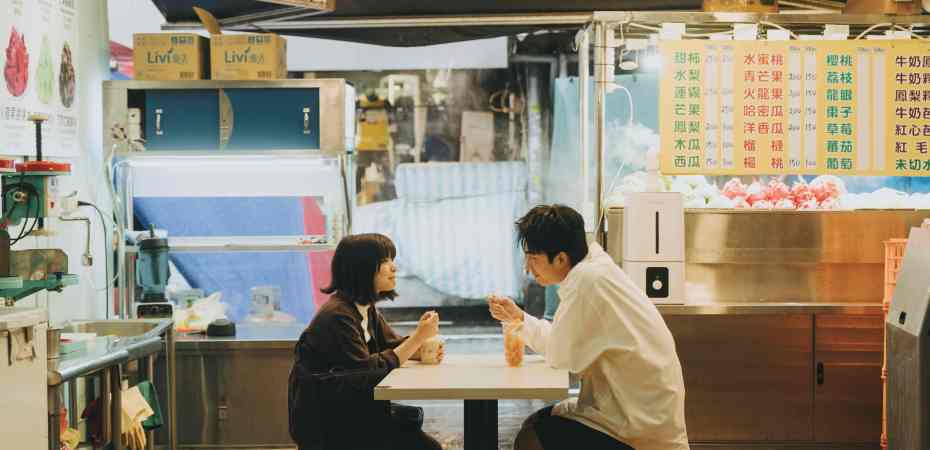
Written and directed by Yukinori Makabe, co-written by Noriko Kato, a young Japanese woman, who is reeling from the death of her much loved mother, decides to take a trip to Taiwanese capital Taipei to try to alleviate her loss. While there, an encounter with a young man sees the pair strike up a tentative friendship that could help her come to terms with the death. Starring: Yukino Kishii, Tseng Jing-Hua, Kisetsu Fujiwara and Seina Nakata.
It may sound a little unoriginal to say that a film is a quiet reflection upon grief, as there have been many of that kind, but Yukinori Makabe’s Sinsin and the Mouse is certainly original. It moves in such a kind, gentle way and manages to impressively hold itself with such a compelling stillness. It spends a lot of time in simple, contemplative moments, observing Yukino Kishii’s Chizumi as she comes to terms with losing her mother. Watching as she moves through her life with a sadness and listlessness, until she comes across Tseng Jing-Hua’s Sinsin.
Then Sinsin and the Mouse opens up into something very different and yet still manages to hold that same strongly pensive tone. The two of them together create this emotionally open and honest space, they may have only just met but the instant connection makes them feel safe around one another. Watching them have that unfiltered, vulnerable conversation is incredibly charming. Part of what helps that endearing nature boost the atmosphere of the film is Makabe’s directorial choices. Along with cinematographer Wayne Lo, they create a clean, tidy aesthetic, visually it’s composed and graceful.
Another part of creating that engaging atmosphere is the performances, Yukino Kishii is simply wonderful as Chizumi. She’s sweet and kind, and it’s refreshing to see a character who is so self-aware of their own struggle and actively taking steps to move forward. She’s got a compelling emotional maturity, reflecting upon the loss of her mother and revisiting memories but also attempting to deal with it in a healthy manner, it’s not something you see very often. Tseng Jing-Hua then creates a great counterpart to those qualities, also dealing with his own struggles, but finding something in Chizumi which helps him to be open about them and share personal stories despite barely knowing her. They make for an adorable duo, they’re irreproachable in their sweetness and kindness.
The only element which strays out of that is how Sinsin brings a slight fetish angle to the table. His fascination with Chizumi’s small stature is slightly uncomfortable, even though it’s dealt with in a quiet manner. It’s one of those factors which is probably culturally divisive, some people may find it less strange than others. The way that they employ the timeline can also be slightly messy, it skips around through past and present and it’s not always initially perfectly clear that it’s moved from one to the other.
Sinsin and the Mouse is delightfully delicate, tender and has such an open, honest heart. Yukino Kishii and Tseng Jing-Hua make for an incredibly sweet pair and it’s very easy to watch them stroll and chat, casually and warmly opening up to one another. The directorial style is elegant and nicely reflects the contemplative, quiet nature of the film. Quiet is definitely a key here and it also moves very slowly, so it won’t work for everyone, but it’s superbly thoughtful and gentle.
 FilmCarnage.com