
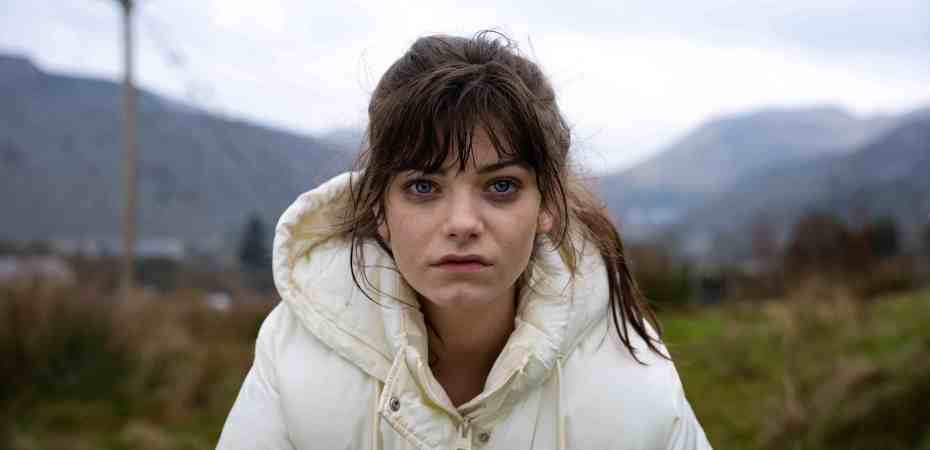
Directed by Marc Evans, based on the play Iphigenia in Splott by Gary Owen, hard-partying young woman Effi lives in rural Wales, whose life largely revolves around drinking vodka with her friends and eating instant noodles to cure her subsequent hangovers – until her life suddenly changes dramatically. Starring: Leisa Gwenllian, Tom Rhys Harries, Owen Alun and Nel Rhys Lewis.
The first thing with Effi o Blaenau is simply that it’s refreshing to see a film set in Wales where they’re actually speaking Welsh. It’s not something you find very often, and it’s great to see Marc Evans make that choice here. Partly as it does more strongly connect it to the setting of the story, being in such a rural, declining town. Evans does well to signify that economic downturn of the once thriving mining town, adding plenty of notes within the shot choices, without having to say it directly.
Initially there’s a very youthful style to Effi o Blaenau, the atmosphere is strongly embracing Effi’s (Leisa Gwenllian) personality and reckless nature. It takes a little while, perhaps longer than was ideal, to move beyond that and shift the tone into something sincere. Then when it finally does, it becomes a great comment on the impact of lack of funding on health services. How running a bare bones operation causes all sorts of dangers for patients. As well as how it’s a no-win situation for everyone involved, it’s a very relevant and poignant message. Behind that is a nicely growing tension which builds terrifically.
The film marks the debut leading role in a feature for Leisa Gwenllian, and she does not disappoint. Watching the evolution of her character is satisfying and moving. Gwenllian brings a lot of passion and determination, as well as the classic panic and denial of youth. Effi o Blaenau almost feels like an everyday origin story for Effi, portraying her journey to finding out who she really is beneath the drinking and partying, changing her perspective and forging a different path.
Effi o Blaenau is a strong comment on the dangers of an underfunded NHS. It wears its heart on its sleeve, it’s not about the layers beneath, it’s straightforward and clear, much like its titular character. There’s some great cinematography from Eira Wyn Jones especially in bringing through pensive landscape shots which boost the atmosphere. That’s then supported by a strong score from Ioana Selaru and Sion Trefor, with an excellent use of strings. The direction is thoughtful and it’s led by an excellent performance from Leisa Gwenllian.
 FilmCarnage.com