
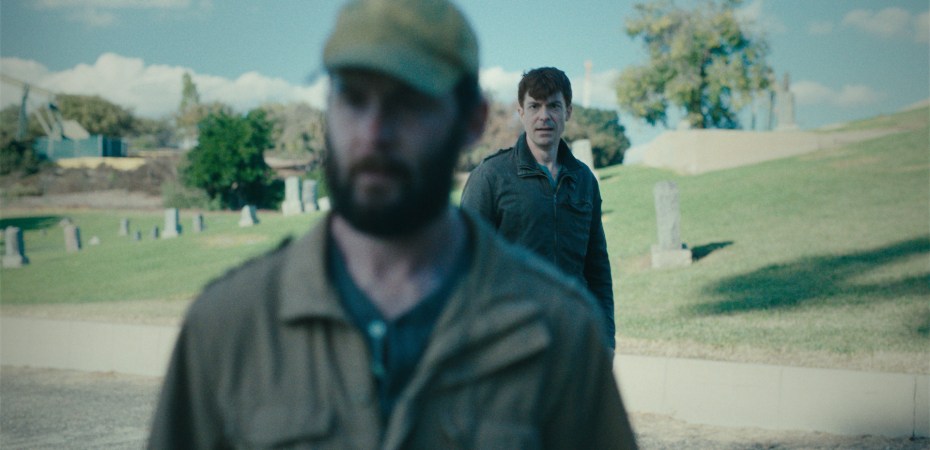
Directed by Hariharasudhen Nagarajan and written by Anghus Houvouras, when a grieving father, who lost his daughter to a school shooting, crosses paths with the clinically depressed ex-school resource officer who froze on the day of the school shooting, what darkness will their encounter unleash? Starring: Nick Giedris, Ben Burton, Laura Faye Smith, Joanna Cretella, Sophia Dawson and Arielle James.
Unquestionably, school shootings are an extremely sensitive topic but there are a handful of great films like Fran Kranz’s Mass which have chosen to approach the subject through the perspective of those left behind, and Tether follows in their wake. Anghus Houvouras also adds a new element to the story which is including not just the parents of lost children but someone who was there to keep them safe but froze when faced with such a traumatic situation. The combination of the two makes the story’s focus on acceptance and moving forward even stronger.
Houvouras’ writing works really well to integrate these two characters, to do justice to both their perspectives, and the middle ground that they share. It’s intensely emotionally charged territory, but it never feels like it’s trying to manipulate the audience. Especially because it spends so little time on the event that caused all this grief, which was a really clever choice. It would have been difficult to explore that further and hold onto its sincerity and earnest nature. Something that it builds right from the very start.
There’s an immediately strong atmosphere, Hariharasudhen Nagarajan injects a great emotional weight to the opening which follows Tether all throughout its runtime. Along with cinematographer Nick Walker, they create this excellent colouring and texture to the aesthetic. It has a tense and complex feel, leaning into the darker hues but never truly becoming gloomy. It adds in an ominous note without stepping outside of the dramatic realm. Especially with the help of the score from Darryl John Hannan, it elevates the film’s tension, suspicion and conflict.
Something that is undoubtedly then enhanced by the terrific performances at the heart of Tether. Ben Burton gives such a complicated, broken portrayal, it’s truly excellent and he opens up so many emotional avenues for the film to explore, ones that audiences might not be as familiar with. Whereas Nick Giedris’ bereaved parent Leonard is more of a known quantity, exploring the deep pain that comes from losing a child. It’s a more traditionally emotional performance and Giedris can try a little too hard in the height of intense scenes but it’s a difficult role and he does a great job.
One of the key topics that the scenes between Burton and Giedris captures is how quick modern society is to blame, resent and hate. Particularly with the prevalence of social media, witch hunts are started in a fraction of a second and can have drastic consequences for their victims. It’s so easy to let that negativity to take hold whereas sympathy and compassion often take work, and Tether is a touching example of that. Portraying how difficult yet vital it can be to see things from someone else’s perspective and appreciate their own struggle, while being blinded by your own rage.
We can never have too many reminders of how important compassion and acceptance are in today’s world and Tether nicely fills that role. It’s tense and filled with a superb emotional weight, the atmosphere is dense with the conflict, grief and regret. It’s shot really well to match that poignant nature to its well written story, with a strong aesthetic and a confident, gradual progression. Hariharasudhen Nagarajan and Anghus Houvouras create a tale of choosing acceptance and letting go of festering emotions that continually drag you deeper into depression. One that’s particularly well captured by the fantastic, complex and moving performance from Ben Burton.
 FilmCarnage.com