
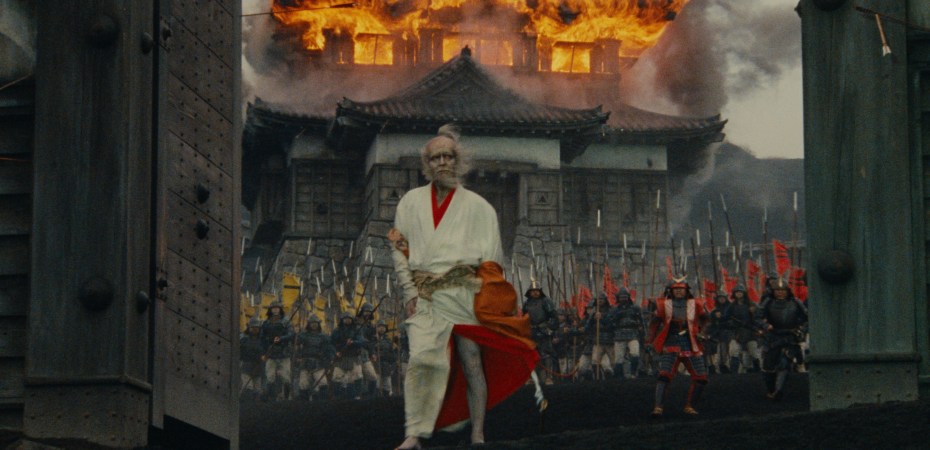
Written and directed by Akira Kurosawa, co-written by Hideo Oguni and Masato Ide, in Medieval Japan, an elderly warlord retires, handing over his empire to his three sons. However, he vastly underestimates how the new-found power will corrupt them and cause them to turn on each other…and him. Starring: Tatsuya Nakadai, Akira Terao, Jinpachi Nezu, Daisuke Ryū, Mieko Harada, Yoshiko Miyazaki, Mansai Nomura, Hisashi Igawa, Shinnosuke Ikehata and Masayuki Yui.
It would be hard to watch a film like Ran and not immediately understand how people fall head over heels in love with cinema. The scale of this film is genuinely epic, even if you ignore for the time being the exceptional visual quality, and simply consider the sets, the costumes, the choreography, the extras, to name a few, it’s something you rarely see anymore. The gargantuan effort that went into making this film is utterly impressive, but of course even more so because it is also a fantastic piece of cinema.
The way that Akira Kurosawa meticulously crafts the visual, alongside cinematographers Asakazu Nakai, Shôji Ueda and Takao Saitō, is almost mindbogglingly creative. Kurosawa captures all of the grounded elements to this story but also adds this uniquely surreal quality to everything. There’s this curious, unusual, theatrical quality to the atmosphere, tapping into something highly dramatic in a classic fashion while simultaneously creating something ahead of its time. Considering this was made in the 1980s, it would perfectly slide into the golden Hollywood era of epic cinema, with one exception, the blood. Adding in viciously bloody touches throughout was such a fantastic choice that adds a heightened feel, striking harder.
Especially when you are talking about possibly some of the greatest battle scenes ever created in cinema. What makes them stand out so much, even forty years later, is partially thanks to composer Tôru Takemitsu. The way that they could have gone the traditional route, adding in an angry, outraged score to drive home the violence but instead choose to reflect the consequences of these actions. They add a poetic quality which makes them hold such deeper meaning and make them more effective, it’s unexpected and brilliant.
There are a lot of ways in which Ran strays away from the traditional path, and all of them add to the quality of the film. It has a strange sense of humour, and gives time to powerful, wilful, vengeful women which is always great to see in a film mostly filled with men. All of the cast are incredible and truly capture that idea that violence and death, beget violence and death, and it’s a deeply sad, wasteful and brutal cycle. They capture how each of them are being haunted by their own decisions and their losses and trauma. Having a film so filled with death and managing to maintain something creative, theatrical and with a sweeping curiosity, is something few filmmakers can achieve but Kurosawa is a master of it.
Ran is another film that’s a classic for good reason, and the anniversary is a good excuse to rewatch it or experience it for the first time. It’s artistic, poetic, moving and brutal, a truly unique blend and arguably one of the best Shakespeare adaptations to ever grace the silver screen. It may ask for a little bit of patience at times and take some wild turns but it’s impossible not to appreciate its prowess. It’s a sincerely epic piece of cinema that any film fan needs to watch at least once, probably twice.
 FilmCarnage.com