
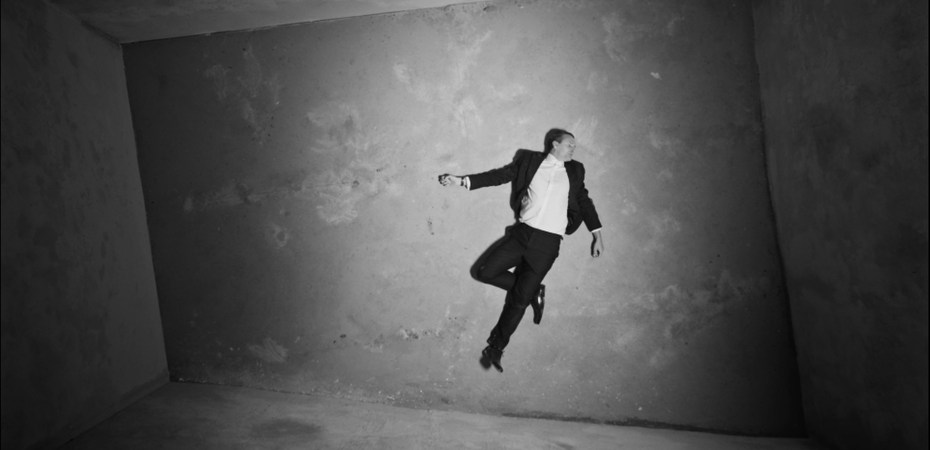
Written and directed by Nicolai Schumann, Rupert (Edward Hogg) wakes up in a locked room without any doors or windows. He has no clue how he got there, and all he has is his mobile phone.
There’s no denying that having almost the entirety of your film take place in one room, with one singular character on camera is setting yourself a hefty challenge, let alone as your debut feature, but Nicolai Schumann was capably and confidently up to the task. Straight away you’re hit with that stunning clarity and texture to Bruce Jackson’s cinematography. The level of detail in itself is immediately captivating and it keeps on going strong all throughout The Lonely Musketeer.
That aesthetic is then beautifully supported by Nicolai Schumann’s direction which is a terrific piece of filmmaking, truly making so much out of so little. To have that single closed room, plain walls, zero pieces of decoration and removing colour from the equation, puts more weight on Schumann to create energy, atmosphere and movement with his direction, and he certainly ticks all those boxes. It surprisingly never feels claustrophobic, while being intensely closed off for the character, it keeps itself on the move and injects a nicely building tension. Perhaps the only choice that isn’t as strong, is including flashbacks and hallucinations, they add a sentimental touch which doesn’t blend smoothly with the sharpness and focus of the rest of the film.
Another touch that helps that tension is the score from Nilly Brook, it feels cleverly minimal, it’s never intrusive or emotionally manipulative, it’s very natural. It perfectly complements Edward Hogg’s remarkably organic performance. There’s huge potential for a one-man portrayal like this to become theatrical and stage-like, pressing buttons in an overt manner, but Hogg avoids that entirely. There’s something to his performance that reminds of Jonny Lee Miller’s brand of confidence, intelligence and bluntness. Hogg captures that great mix of nonchalance and manipulation, he’s frank but always thinking of the endgame. He builds this almost anti-hero charm, he’s clearly selfish, vain and entitled but you still can’t root against him, and as time goes on, he only gives you more reason to be invested.
In no small part due to the excellent progression that the writing takes. Again, it’s tricky to get the pacing and movement of the story right for this type of film, to make it gradual but not too slow, and to not reveal too much too fast but The Lonely Musketeer hits the nail on the head. It moves with confidence and keeps adding to itself. There’s something old-fashioned to it, it’s the type of story you might find in a lot of beloved crime thrillers from the 1990s, and yet it also feels modern and unexpectedly relevant. It’s as if it’s subconsciously tapping into nostalgia without being forthright about it.
The Lonely Musketeer is a fantastic example of what independent film can achieve. Nicolai Schumann has unquestionably knocked it out of the park with his debut feature. It’s remarkably shot, it’s cleverly written, it’s enthralling and is led excellently by Edward Hogg with a career highlight performance. Not to mention Schumann is backed by a highly talented crew, Bruce Jackson’s cinematography is exceptional and the score from Nilly Brook is well chosen. Also just to note for anyone not familiar, and might question the battery life of Rupert’s phone, do not underestimate those old-school Nokias, they’ve got battery for days, we’ve just become far too used to modern smart phones with terrible battery life.
 FilmCarnage.com