
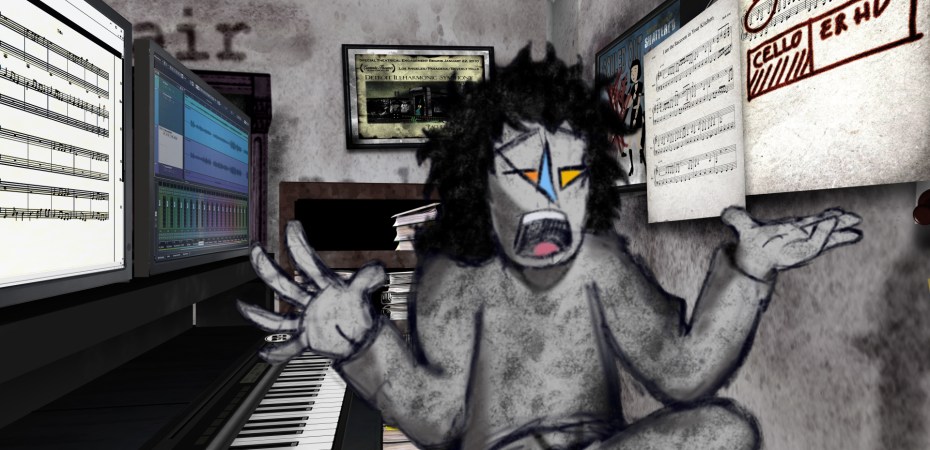
Written and directed by Walter Santucci, a failed rockstar (known only as “Human”) is living in an abandoned, burned-out church, where he has a long philosophical discussion with two Muppet-like puppets (“Foo” and “Satchmo”) about the meaninglessness of life. Voiced by Jack Grisham, Kristina Wong, Keith Morris, Annie Cruz, Evelyn Vasquez, Tony Nittoli, Drew Stone, John Andrews and Tamadhur Al-Aqeel.
Diving into I’d Rather Be Turned into Cat Food, you’re immediately hit with its raucous style. It’s reminiscent of the heyday of MTV, an abundance of energy and following a flow of creativity rather than specifically constructed. With the exception of the tone, which taps into that punk rock vibe, anti-establishment and hugely critical, but not necessarily apathetic. There’s a curiosity to it, there are notes of aggression and hostility, but they serve the passionate nature of the film’s debate rather than adding a negativity.
The philosophical, theological discussion that the protagonist embarks on with two puppets is surprisingly sincere. There are a lot of good questions that cover ground that will be relatable to most. While it can be very brash and a little vulgar in its language towards religion, it never feels outright derogatory, although to the most devout it probably would. Part of the reason why it holds onto a more open, honest feel rather than irrevocably cynical is that choice of the puppets. It takes the tone of something like Sesame Street or Mister Rogers’ Neighbourhood and makes it adult. It’s encouraging you to open up your perspective, to not just blindly believe what you’re told.
Walter Santucci employs a lot of variety to have that discussion, not simply within the animation styles but also in the tones and thematic elements. Particularly with how Santucci uses music, adding original songs is always a risky move but it works well in I’d Rather Be Turned into Cat Food. There’s one song that feels like something Jason Segel’s character from Forgetting Sarah Marshall could have written, in a fun way, it’s a shame there aren’t more inclusions like that throughout the film to expand the story. Santucci’s use of colour is another strong choice, to accent scenes rather than bombard them, garnering more of its energy through its movement and restlessness. It provides the film with a kind of urgency, it’s forever moving.
Another part of why it’s able to create that accessible tone is through the voice work. The leading trio really push that sense of curiosity, the personalities they create are friendly but in a less traditional way. They tap into that classically educational feel but blend it with a bit of trauma, to give it a brooding edge. It’s a unique mix but it holds the attention well, it has a unexpectedly sympathetic quality and it’s passionate in a critical way without becoming too harsh or stubborn.
However, it can still occasionally step over the line, especially with the use of graphic imagery of violence against animals. You can see the intention to make a strong point about caring for others but it’s too much and comes completely out of nowhere, so it feels even more uncomfortable. It also can occasionally get wrapped up in the fervour of its monologues and go slightly overboard, pushing beyond the impassioned anger of the rest of the film. It also goes surprisingly light on the satire, it feels like there was a big opportunity for a huge satirical vein with a hint of absurdism, but it doesn’t fully embrace the comedy side of things.
I’d Rather Be Turned into Cat Food is extremely creative and brings a great amount of variety into its animation styles. It strongly taps into that punk and anarchic vibe while holding onto a curious yet frank tone. Occasionally it goes too far, and its anger becomes misdirected, making a few overly brash choices. It also feels as though there could have been a better balance between the discussion and the underlying story, there was more to explore that had a lot of personality to offer which only comes out in its final scenes. As well as keeping its comedic notes mostly on the sideline. However, it’s full of righteous angst, does well to create that clever balance of tones and manages to impressively have a cynical nature without becoming depressive, there’s a positive message about opening your perspective hidden beneath its anguish.
 FilmCarnage.com