
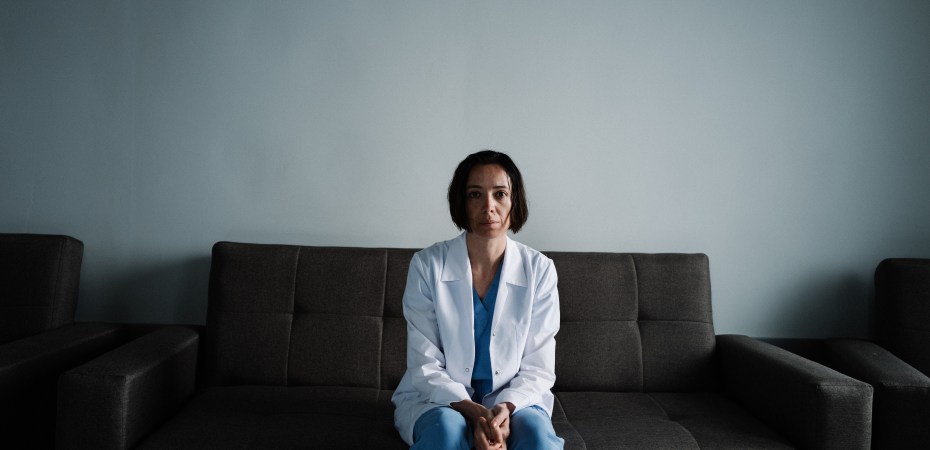
Written and directed by Dea Kulumbegashvili, Nina, an OB-GYN, faces accusations after newborn’s death. Her life undergoes scrutiny during investigation. She persists in her medical duties, determined to provide care others hesitate to offer, despite risks. Starring: Ia Sukhitashvili, Kakha Kintsurashvili, Merab Ninidze, Roza Kancheishvili, Ana Nikolava, David Beradze, Sandro Kalandadze and Tosia Doloiani.
Firstly, it can’t be denied how impeccable the visual is with April, the cinematography from Arseni Khachaturan is striking, rich and full of depth. Dea Kulumbegashvili and Khachaturan create a pervading atmosphere of pain, keenly portraying the lack of empathy towards women in society but particularly when it comes to their health. There’s an unusual, obscure quality to the shots that Kulumbegashvili chooses, building a mix of being either uncomfortably close or viewing from afar. She also employs a use of graphic imagery which makes its point unreservedly and boldly.
As the film moves through Nina’s (Ia Sukhitashvili) story, there are plenty of notes of desperation, abuse, vulnerability, loneliness, exasperation, disillusionment and the sense of being lost or adrift. There’s an intentionally strained quality to the air of April, however the style that Kulumbegashvili employs is classically auteur filmmaking, it’s niche viewing and will not be for everyone. In that sense, it can also be quite cold, distant or even confusing at times with the ambiguous choices that it makes. It will work for some but not for everyone, it has an unwavering commitment and it’s striking but it does beg the question of whether it truly does justice to such an important subject?
By making such artistic, bold choices, is it removing the everyday? Pulling the film away from its realism and how this is an absolutely vital topic which is impacting countless women across the world at any given moment. The intention is unquestionably there and the feeling but it’s elevating it to something almost ethereal which doesn’t serve to drive home the everyday struggle. It’s fighting against itself, at one moment using extended scenes to loudly portray the pain, although they are occasionally over-extended and slow the film down a touch too much. Then at another moment it’s drifting away into other facets of psychology and exploring them in a way which feels abstract. The two don’t necessarily work together in perfect harmony.
Another element of that is how it uses the performances because they can feel secondary, as if the initial character is the lens, not the people in the story. The performances themselves are all excellent, they capture the dour, depressive and clinical nature of the themes. Ia Sukhitashvili is superb in the lead, portraying the generous and dedicated nature to Nina but also the brokenness and isolation. Kakha Kintsurashvili then makes for a great pairing to those notes, enhancing them further and capturing his own version of a fractured life.
April is immaculately shot, the cinematography is beautifully layered and bold. Dea Kulumbegashvili chose to tell this story in a uniquely artistic way which bolsters the visual in a highly memorable fashion but perhaps doesn’t do justice to the importance of this topic. Kulumbegashvili absolutely captures the cold-hearted nature of how women’s health is often handled but focuses so much on an atmospheric style that it draws away from the grounded nature of these subjects. Ultimately, while being well made, it’s pushing the topic into niche territory which will be appreciated by a fairly limited selection of viewers rather than opening up a larger discussion.
 FilmCarnage.com