
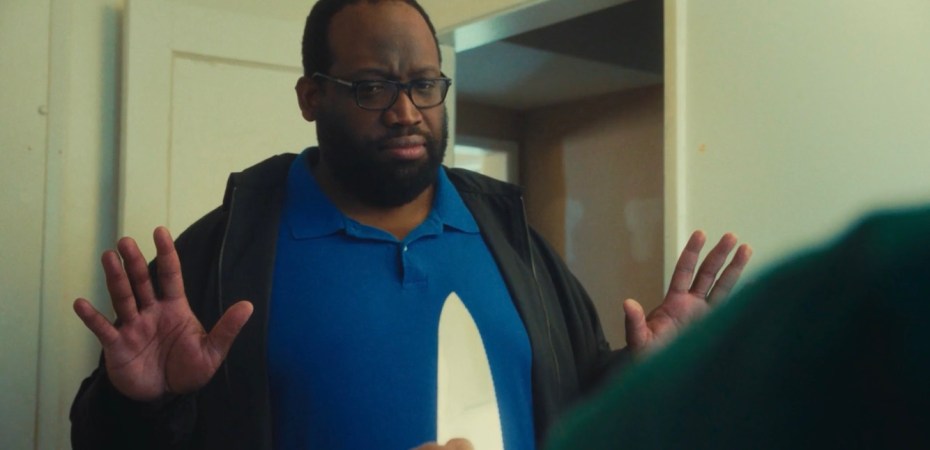
Written and directed by Marcellus Cox, a young man relapses, missing his one year sobriety anniversary party at his local AA support group. Starring: Antwone Barnes and Sean Alexander James.
As soon as you enter Liquor Bank, you’re hit with the wonderful grain that cinematographer Fabian J. Tehrani captured. It creates a well-matched texture to the story’s emotional foundation. There’s something nostalgic and earnest about it, portraying the everyday without letting the visual become overtly simple. The editing from James L Gilmore Jr., then nicely adds in layers on instability and fragility, paired well with the movement that Marcellus Cox employs in his direction. That choice to not keep a stillness was a good move to portray the precarious position of Eddie’s (Antwone Barnes) sobriety and mentality.
Another element which quickly stands out is the performance from Sean Alexander James, who was also a highlight in Marcellus Cox’s previous film Mickey Hardaway. The composure and patience which he brings to Liquor Bank, is exceptional. His portrayal drives the film to be a portrait of the power of generosity, and the meaningful and lasting impact that sort of support can have. James’ performance is emotional yet reserved, it’s perfectly timed to show how his character knows how to push the right buttons and when to step back.
Antwone Barnes’ Eddie provides James’ Baker with plenty to battle with. Barnes’ performance has more familiar notes to it, the disillusionment with life and classic tendencies of alcoholism. He brings a nice note of aggression to it, but he can struggle a little bit in the heights of the emotional scenes. Particularly in one very direct shot, capturing the fairly stereotypical tearing up which it didn’t feel like Liquor Bank necessarily needed. The same would go for a very brief moment where it almost feels like it’s about to take on a first-person perspective, as it leaps into an action-style mode. It didn’t quite blend with the style of the rest of the film, but the direction is otherwise well thought out.
The writing has a slightly theatrical tone to it, the way that it moves is as if it would translate into a one-act play on alcoholism and the struggle of sobriety. It’s natural but purposeful, trying to communicate the weight of the issue rather than simply being casual. It’s one of the elements which helps to build the presence of Liquor Bank, which is strongly relatable and engaging. The pacing is well done, and Marcellus Cox does a good job of holding onto an intimate, personal feel throughout the film. Something that’s aided by the strong score work, which has a great bold quality.
Liquor Bank is a testament to the power of generosity, and the meaningful impact found in a willingness to stick with someone no matter how harshly they push you away, and to guide them towards better choices. It’s shot well to reflect the emotional nature of the film, with a particularly strong grain and texture to the aesthetic. The editing and score do well to enhance the tension and feeling, while the directorial style adds in a good amount of movement to reflect the fragile nature of Eddie’s mental health. Sean Alexander James gives a fantastic performance that feels like the heart of the film, with such a giving and kind presence.
 FilmCarnage.com