
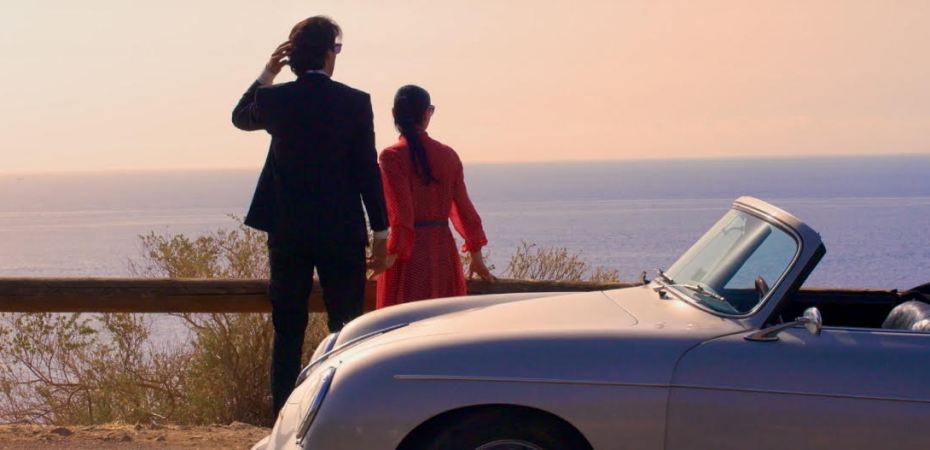
Written and directed by leading actors Guillaume Campanacci and Vesper Egon, in the south of France, Guillaume is a suicidal Frenchman. Vedrana is slowly dying in a loveless relationship. She is determined to make him love again, but his former fiancée shows up at his doorstep, pregnant with his child. Also starring: Jean Vincentelli, Nathan Dellemme, Alexandra Dellemme, and Léo Marty.
One of the things you’ll quickly notice with Whenever I’m Alone with You is how relentlessly it pays homage to pieces of iconic cinema, right from the first scene. Very clearly the filmmakers have a dedicated love of Jean-Luc Godard, even going so far as to include some intentional misogyny to truly write a love letter to him. However, when these nods are so frequent, all throughout the film, it loses its own identity.
What we get instead is a lot of different things thrown together, not genuinely attempting to create a story but simply experimenting with a number of styles. It’s difficult to establish what it’s trying to achieve with its experiment, it feels more like the filmmakers were making something for themselves than for an audience. They’re playing around and as the fourth wall is fairly thin, you can tell that they had a good time with it but it’s not particularly satisfying or captivating to watch.
In the same way, it’s difficult to really judge the performances because they don’t entirely feel like true performances. They’re similarly experimental, playing around with the ideas of romance and anti-social behaviour. They create relatively dislikable characters in the more traditionally structured moments. Guillaume (Guillaume Campanacci)is moody in a way that you could get away with a few decades ago but now feels egotistical. Vesper Egon’s Vedrana feels slightly more accessible but does still make some strange and abrasive choices. There’s also a tendency to lean on intimate scenes too much which don’t have a great deal to add.
Whenever I’m Alone with You feels like it was made for the filmmakers themselves rather than for viewers. They clearly have fun with paying homage, getting their family involved and experimenting with different styles, but to an outsider there’s not much to follow and it’s relatively inconsistent. It draws a lot from the 1980s and classic French cinema, and not all of those themes translate well to today. It’s drawing from so many other influences, it’s hard to tell what part of the style is actually theirs.
 FilmCarnage.com