
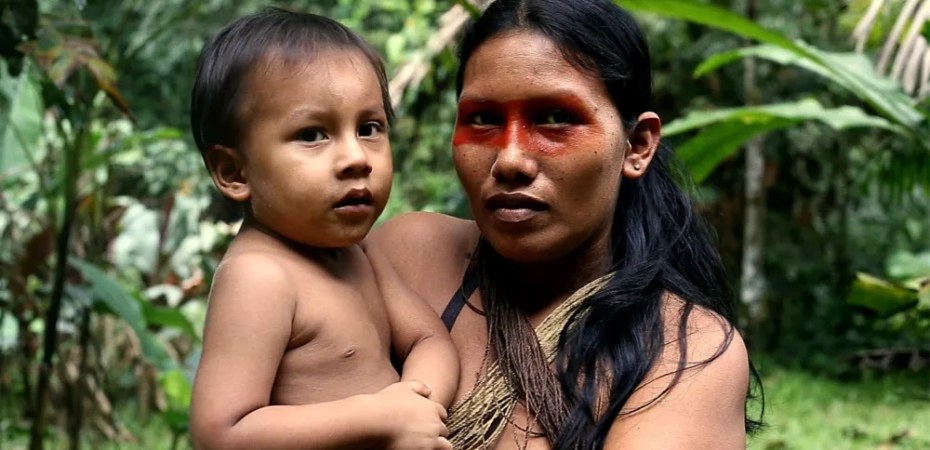
Directed by Luisana Carcelén, for thousands of years, the Waorani women of the Ecuadorian Amazon have lived in perfect harmony with Mother Earth in the most biodiverse spot on the planet: the Yasuní. They have coexisted within this delicate ecosystem, allowing them to flourish while preserving their unique customs and traditions. However, the winds of change have swept through their lands, and now, the sacred place that grandmothers, daughters, and granddaughters have cherished as home stands under grave threat.
The style that Luisana Carcelén bring to Waorani: Guardians of the Amazon is immediately bright, both in colour and in spirit. It leans into its subjects’ connection to nature, bringing a raw edge and combined with the editing work, it builds extra layers of intrigue and depth. However, as it moves forward, it’s trying to pull together a lot of information, covering decades of their lives which is a little too much to do justice to.
Its key message is absolutely there, following a pattern of outside interference and the following negative impact. How their way of life and land are constantly facing new threats despite only ever existing within their own community. It’s a familiar story for many indigenous populations across the world, it would almost be unbelievable that people have to fight for land they’ve lived on as far back as records go, if it weren’t for the intense greed and egoism of the world.
While that story certainly gets through, with all that information and generational experiences, it can feel somewhat messy. It’s very quickly jumping from archive to recent years, with a lot of back and forth which doesn’t feel like a linear or smooth flow. Especially considering that it’s coming in at just over thirty minutes, it had the space to re-organise itself into something more gradual and growing to really let the impact of its final scenes land.
Waorani: Guardians of the Amazon portrays the wild and widespread mistreatment of indigenous peoples and the many attempts to undermine their rights. Its progression may be messy, but its message is loud and clear, the erroneous nature of communities having to fight to preserve land which has always been theirs. Constantly being forced to defend their way of life from people who don’t understand it. It’s a more than worthy subject presented with a strong style.


Esteemed Film Carnage team, I am Luisana Carcelén, director and producer of the documentary. First of all I thank you for taking the time to review the film, and for your good comments, however it is very important to clarify that the short film version you have reviewed has been made in an abusive and illegal way by Mr. Luis Fernandez, aka Jamanicanoproblem, who at no time has been co-director of this documentary and who did not even participate in any shooting. As a producer, I signed a couple of years ago a distribution agreement with his company, in which it was agreed that this person would act as creative producer, but at no time was he authorized to make a short film version of the documentary, which is a feature film, much less act unilaterally, without my consent or participation. This situation responds to a serious appropriation of the work I did for ten years, with genuine recognition and affection for the indigenous communities, and has been used in a misappropriated way to promote a supposed filmmaker who is known in Ecuador for his fraudulent practices with other filmmakers, a situation that I unfortunately discovered late as the years went by.
The original version of the documentary is 70 min. so I understand, and agree, that your critic points out that it condenses a lot of information in very little time, although this version has not even been shared with me for my review. I share a link that supports previous screenings of the documentary in its original version: https://www.lineaimaginariacinema.com/2022/waorani.html
LikeLike