
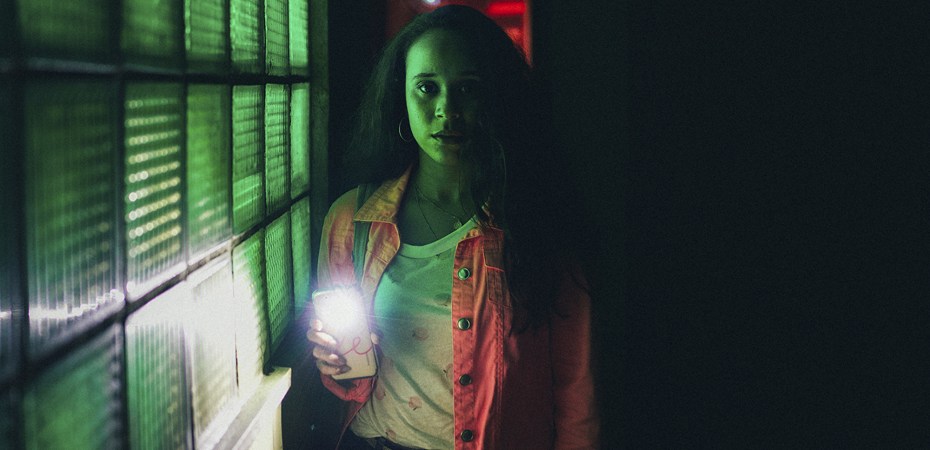
Written and directed by Anita Rocha da Silveira, in order to resist temptation, Mariana and her girlfriends try their best to control everything and everyone around them. However, the day will come when the urge to scream will be stronger than it ever has been. Starring: Mari Oliveira, Lara Tremouroux, Joana Medeiros, Felipe Frazão, Thiago Fragoso, Bruna G., Bruna Linzmeyer and Carol Romano.
The first thing you have to talk about with Medusa is how incredible it looks because João Atala’s cinematography is so sharp, mysterious and edgy, which when paired with Anita Rocha da Silveira’s direction, is impressively strong. Interestingly, as it opens it hits a hard, odd note which is difficult to decipher, putting viewers into a curious position. It brings this tone of artistry but is veiled in strangeness, which once you dive into the rest of the film, makes a lot of sense.
The atmosphere and tone linger on the edge of horror while the rest is an unusual mix of thriller and fantasy, meets almost a dystopian, very close future. It’s somewhere between Dario Argento and giallo cinema, and Neon Demon’s flashy, violent style. Impressively Anita Rocha da Silveira manages to keep that tone going all throughout Medusa, it’s extremely consistent.
Although it does feel more indulgent as time goes on, it runs long at over 130-minutes and it has a penchant for drawn out shots which don’t have much to add. It’s a shame to see as the sharp edge the visual builds is slowly being dulled by the hesitant and pensive movement and progression of the film.
While that visual element is so strong, the story is more of a mixed bag. There’s undoubtedly a strong concept at its heart, with a lot of poignant debate surrounding youth today, vanity and a return to misogynist values. However, it never feels inherently political which is going a positive or negative depending on the viewer. There are aspects it touches upon, repression, herd mentality and the physical drain of being indoctrinated and self-righteous but it never takes a deep dive, only dipping its toes into them.
It’s primarily the pacing that lets Medusa down because looking at it as a whole, there isn’t a lot to its plot, and there’s an argument to be made that it could have been more effective if it had held itself to under 100-minutes. After about the half way point, it begins to take a lot of tangents, becoming distracted and though it does eventually find its way back, it feels too late to recover.
Additionally, there’s the issue of spending too much time where it doesn’t need to. For instance the preaching and young men’s vigilante group, they’re easy to establish elements so they really didn’t need as much time as they got. That’s in part because the real strength of this story is with its leading women, they’re complex and conflicted, taking attention from them, isn’t to the film’s advantage.
Starting with Mari Oliveira who presents the middle ground, she’s got one foot in, one foot out of this cult-like religious group, seeing the cracks in its façade after her beauty is challenged. Oliveira gives a superb performance but there are times when the story simply lets her drift rather than take charge. Whereas Lara Tremouroux gives us the feel of if Regina George joined a cult, she’s forceful and unforgiving in the most righteous of ways. However, as the film gets into its latter moments, viewers will realise there’s a lot more to her character, and it feels as though Medusa doesn’t fully explore that, which is disappointing.
Medusa has a stunning visual, it’s rich and sharp, it’s filled with this darkly satisfying palette and it truly embraces the horror, thriller elements to the story. However, the story holds it back from being great as a whole. It loses its way the longer time goes on, in the beginning it’s biting but it struggles to hold onto that, becoming increasingly unfocused as it moves forward. The leading performances from Mari Oliveira and Lara Tremouroux are fantastic, and there was a lot of violent, poignant and sadistic potential here but it goes unfulfilled.
Verdict: ✯✯✯ | 6/10
In UK cinemas & On Demand from 14 July
Available on Amazon Prime, Apple TV, Google Play, Curzon Home Cinema and BFI Player
 FilmCarnage.com