
Written and directed by Marcellus Cox, a young sketch artist agrees to an in-house therapy session with a well renowned psychiatrist as his life begins sprawling out of control after years of physical and verbal abuse has finally taken a toll on him. Starring: Rashad Hunter, Ashley Parchment, Stephen Cofield Jr., Dennis L.A. White, Samuel Whitehill, Gayla Johnson, David Chattam and Sean Alexander James.
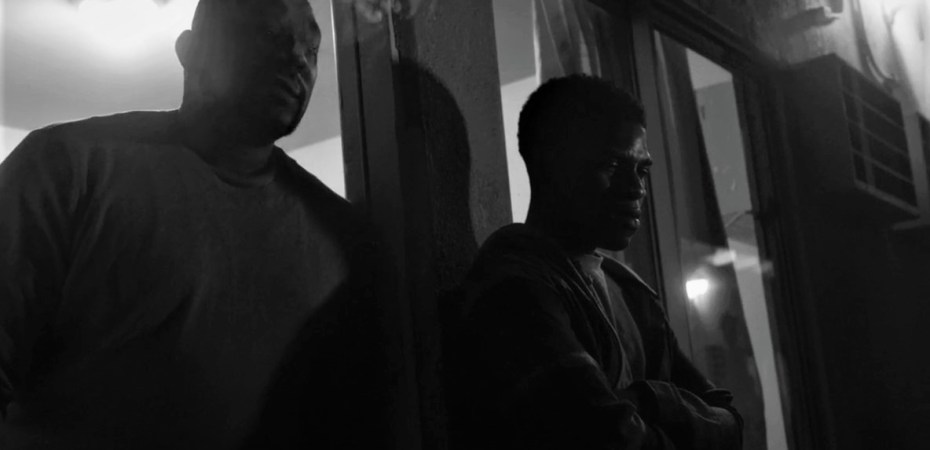
In today’s film landscape, choosing to use black and white comes with lots of advantages and disadvantages depending on how it’s used, thankfully in Mickey Hardaway it makes for a great fit. Immediately you’re struck by the great texture to the visual, Jamil Gooding’s cinematography helps to lift the aesthetic to make that choice feel purposeful and impactful. It’s a choice that was clearly intended to help keep the focus strongly where it needed to be, pushing the weight to the drama that this film has to offer. In many other examples it can feel superficial but here it works well, because it holds onto plenty of sincerity.
The story is really showing the two sides to this coin, the abuse and disadvantages faced by young Black men but also the different ways to attempt to build a better future. Particularly in the sense of featuring therapy, there’s still a fair amount of stigma around discussing mental health in working class communities so it’s rare to see it featured in a film like this, that’s focusing on the harsher side of life.
Those grittier elements are pretty much along the lines of what you expect, although that’s because they’ve been experienced by so many, they become stereotypes. Especially the cycle of violence and toxic masculinity, creating a warped psyche of pushing your child to do what you think is right, to earn a living, in a misguided attempt at protection. Ending up with a closed circle of the crushed dreams of one man, leading to crushing the dreams of the next. Although one of the more positive elements is how Mickey Hardaway shows the importance of teachers who go the extra mile. It’s been done before, yes but it makes it no less valuable of a lesson, when young people don’t have that positive, encouraging influence at home, teachers become even more vital.
There’s one key choice that Marcellus Cox makes with this script that will very likely divide viewers, and that’s the ending. Not because it doesn’t fit or it’s controversial but because it chooses the difficult path, it chooses to stick to its principles. It won’t work for everyone and it is a slight shame to not see it take a higher road but at the same time it’s easy to see the motivation behind it. Much like the rest of its story, it’s creating a reflection of how young Black men are treated by, and frequently let down by, society.
Rashad Hunter leads the story well, it’s a tricky role to pull off convincingly and he does a great job. There’s a plethora of emotions at work within Mickey and Hunter does well to make you relate to his ever changing feelings, guiding you through his tumultuous journey. The whole ensemble are hitting solid notes, one particular stand out is Sean Alexander James, he only gets a short amount of screen time but helps create one of the most memorable scenes of the film. It’s an emotionally charged moment of gaining perspective and James provides a resounding and wholesome presence.
Mickey Hardaway is a strong feature debut from Marcellus Cox, there’s a palpably tense atmosphere running throughout and the story has a great weight to it. It’s rooted in reality but it’s not trying too hard to be gritty or grim, it nicely lets the harshness of Mickey’s reality speak for itself. There are a few clichés along the way, the score can feel out of place and the ending takes a big swing that will be hit and miss for viewers but Cox has created something sincere. It captures the frustration of a community constantly put fifty yards behind the starting line, having to work twice as hard just to reach the first step. Asking the question of, if that’s how society treats them, why should they work so hard to prove them wrong?.
 FilmCarnage.com
[…] performance from Sean Alexander James, who was also a highlight in Marcellus Cox’s previous film Mickey Hardaway. The composure and patience which he brings to Liquor Bank, is exceptional. His portrayal drives […]
LikeLike