
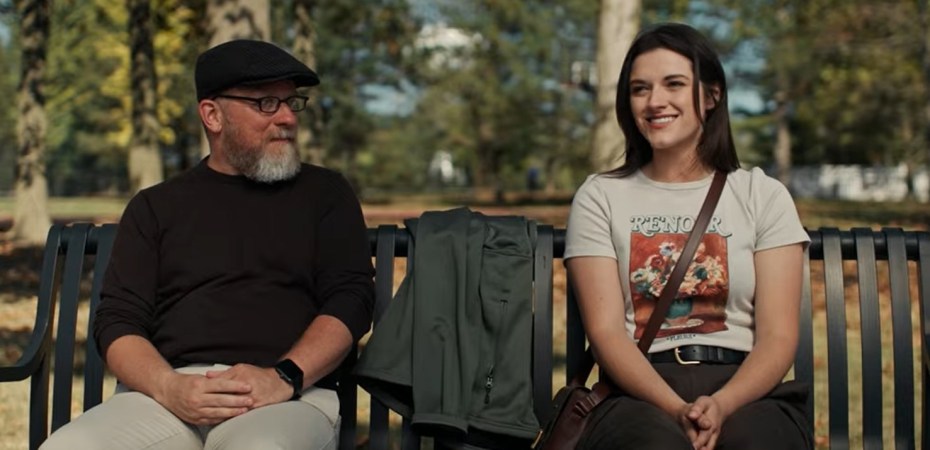
Directed by Arielle Carroll and written by Timothy J. Cox, who also stars in the film, several years after the car accident that took his son Dan’s life, his father Harry, still grieving, reconnects with Dan’s girlfriend Abby to celebrate Dan’s life and reconcile their loss. Also starring: Ashlee Lawhorn and Daniel Griesheimer.
A lot of films exploring grief tend to focus on the initial fallout after a loss, the struggle and shock but Let Dan Go takes things in a different direction. It’s not the before and after, Timothy J. Cox chooses to establish how the loss occurred and then skip down the road to years later. Choosing to explore how that grief continues and follows you throughout life but at the same time creating a refreshingly healthy perspective. Cox’s writing acknowledges that while those feelings remain, you can make choices to continually process them, while maintaining positive relationships, and not maintaining those that are detrimental to your mental health.
The writing holds a very grounded tone and a calmness which pairs so well with its healthy reflection. There’s a thoughtful nature to both the writing and Arielle Carroll’s direction. Carroll goes for a defined contrast in the chosen styles, starting things off with a lot of movement, a darker, richer cinematography and a hint of chaos before slowing things way down. There’s then a lot of stillness and quiet to reflect the peaceful conversation between Abby (Ashlee Lawhorn) and Harry (Cox). Especially in those scenes it almost feels more like it was built for the stage.
However, that transition from one to the other can feel jarring. The style in the latter portions is simpler; the aesthetic is overly bright, and it doesn’t have the same compelling feel as the opening scenes, which misses the opportunity to add some depth. The work itself is solid, but it can’t quite move into more powerful territory. With Let Dan Go having such an emotional foundation, it would have been great to see it reach slightly bigger heights and find a better balance between the tone and visual to fulfil that potential.
Whereas the performances are an element which add a great consistently throughout Let Dan Go. Daniel Griesheimer opens things well with those notes of alcoholism and self-destructive behaviour. Ashlee Lawhorn gets a good chance to show a range here, with the exasperation, frustration and pain of the opening before moving onto a positive, centred portrayal in the later scenes. While Timothy J. Cox brings a stoic yet sad presence, it’s moving and there’s a strongly contemplative tone the portrayal with touches of vulnerability. Cox and Lawhorn make for a great pairing, they create a sincere connection.
Let Dan Go is an interesting change of pace to exploring loss, slowing things down and taking a look at what healthy grief looks like. Portraying the idea of making healthy choices to respect and remember that person in your life, but not allowing it to prevent you from moving forward and enjoying your life. The different styles between the chapters of the film unfortunately don’t gel strongly, there’s too much of a contrast, and the later aesthetic needed a stronger texture or another element to help add some depth in order for the film to reach its full potential. However, it’s touching and thoughtful and led by grounded, lovely performances from Ashlee Lawhorn and Timothy J. Cox.
 FilmCarnage.com