
Written and directed by Mekhai Lee, Andrea “Drea” Stoney, a queer, Deaf poet, feels isolated at her grandmother’s repass, surrounded by a distant family uninterested in ASL. Seeking refuge in quiet corners of the family brownstone, her world is further shaken when her estranged father Samuel—temporarily released from prison after 20 years to mourn his mother—arrives. Bound by grief and blood, father and daughter must confront their strained relationship and find fragile reconciliation before his return behind bars. Starring: Angel Theory, Biko Eisen-Martin, Carrie Compere, Erika Hamilton, Blake McLennan and Mykee Selkin.
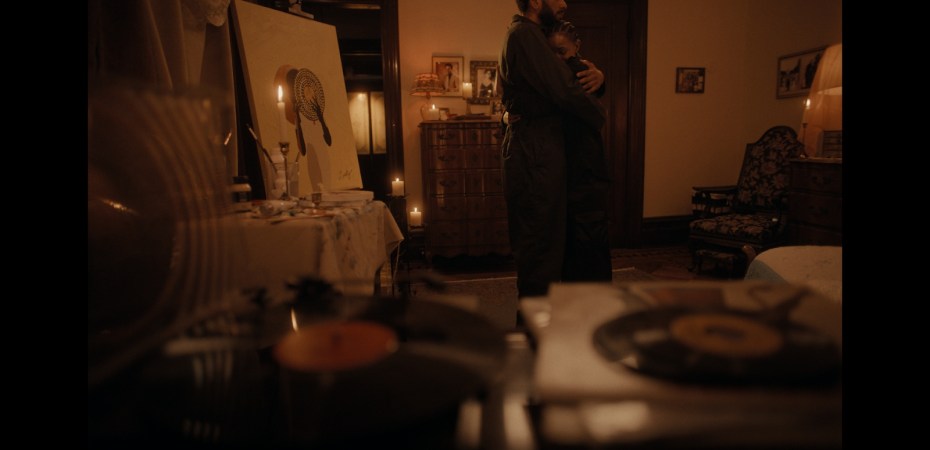
Them That’s Not makes one hell of a first impression with cinematography that would pair beautifully with work like James Laxton’s on If Beale Street Could Talk or Adam Newport-Berra’s with The Last Black Man in San Francisco. Sade Ndya brings such a compelling texture to the visual, the colours have sincere depth and there’s a complex warmth to it. Portraying that feel of a family home, with its welcome embrace but also complicated background. Ndya’s work strongly helps to establish the film’s enveloping and enthralling atmosphere.
Another key element to its introduction is the performance from Angel Theory. She immediately adds a pensive quality, she has a very strong presence and so easily communicates the complicated nature of the relationship Drea has with her family. Theory gives an excellent performance, it’s sincerely moving and is so impressively layered. Biko Eisen-Martin is similarly wonderful as Drea’s father, Samuel. The key scene between the two of them is expertly done, every visual and sound choice perfectly captures the moment, providing the space for these two give phenomenal, heart-rending portrayals.
That use of sound is something that’s brilliant all throughout, used in such a way to succinctly represent Drea’s experience. It elevates the scenes and boosts the emotions, it gives the space to capture that disconnect between the family, and how those experiences can be overwhelming or confusing. On top of how they haven’t ever taken the time to learn much ASL, or any at all, as well as how they don’t have the consideration to at least speak clearly, facing her so that she can read lips. It’s a wonderful example of how people can simply make small adjustments to be considerate, and yet they fail to make that choice.
Mekhai Lee captures a lot of different issues with his script for Them That’s Not. The family conflict and grief are only the beginning, there’s all sorts of layers weaved into the writing. Another one that stands out is stereotypical gender roles, with the family making comments about Drea’s appearance. It’s hard to believe in this day and age there are people who still expect every woman to put on a dress or heels, or fit that clichéd mould, and yet there are plenty.
Especially because it’s so strongly connected to Drea being queer, and how people with old-fashioned ideals try to encourage hiding that in public with a guise of loud femininity. Which also ripples into her being pushed to the outside because she’s deaf. Lee does a great job of capturing a lot of the different ways people can quietly, casually or indirectly be rejected or distanced from their family.
Them That’s Not is a beautiful short film. It’s impeccably shot, the cinematography is superb and it holds such a deeply moving atmosphere. Angel Theory gives a fantastic performance, the level of communication and complexity, especially in moments without dialogue, is genuinely impressive. Her scenes with Biko Eisen-Martin are incredible, the film is already so well made to that point, to then finish it off with this remarkably touching scene, creates something very special and highly memorable.
 FilmCarnage.com