
Directed by James Mansell and written by Bradley Harper, the year is 1888 and the Whitechapel murders continue to ravage the East End of London. Fate has brought together an unlikely alliance who must put aside their differences and unite to end the autumn of terror. Starring: Lauren Cornelius, Matthew Lloyd Davies and Rafe Bird.
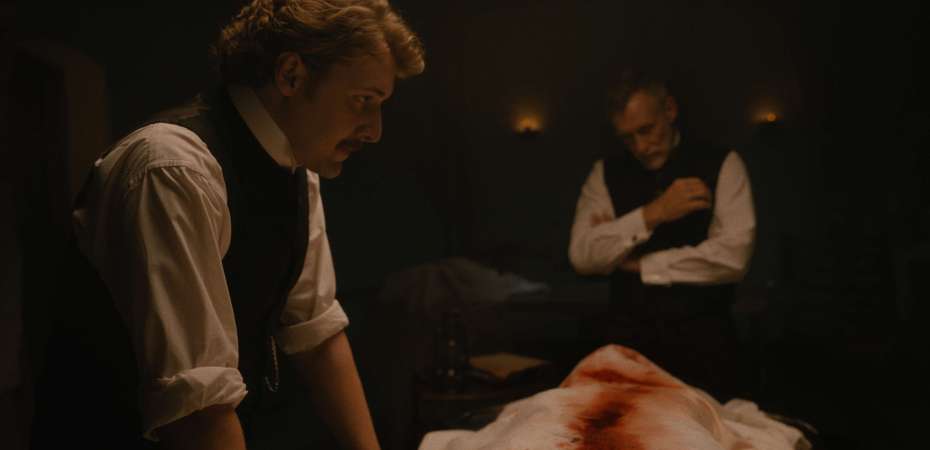
Making a strong, immediate first impression is always going to be a huge benefit for any short film and one of the key factors to achieving that is the visual quality, and as soon as you enter Leviathan, you’re hit with its sharp, rich aesthetic. The suaveness to its colour palette is enough to draw you in. James Mansell nicely leans into the era, and capitalises on those darker shades, deep reds and browns. It quickly sets a compelling atmosphere, something that’s then improved further by Mansell’s choice to add movement. It would have been easy to primarily use still shots, but adding in that little bit of a judder almost, was a good move.
The stage is well set for the era purely from the visual, especially with the great costume and set decoration work, but then as the dialogue comes in, that’s strengthen even further. There’s something very nostalgic about Bradley Harper’s classic detective dialogue, with the slightly flowery language of the 1800s. The tone and style feel reminiscent of the highly underrated series, The Alienist, based on the series of crime novels by Caleb Carr, starring Daniel Brühl, Dakota Fanning and Luke Evans. Especially having a determined, curious leading woman, unshaken by violence.
All of which is supported by a fantastic score which is especially empowering and spirited in the latter scenes, truly boosting Leviathan’s atmosphere and captivating quality. The tone on the whole has a great classically theatrical feel, while the way that it moves feels like we’re watching the pilot for a crime mini-series. One that viewers would likely happily watch after their first taste of Leviathan. Its only weakness on the technical side of things are its choices with transitions. The strength of the short is in its intimacy and tension, keeping things closed in and focused, so when it shifts outside of that to move from scene to scene, it’s unfortunately undermining itself. It gives the audience a chance to drift away, which in this day and age is something you definitely want to avoid.
The tone that James Mansell and Bradley Harper create is something that’s keenly reflected by the performances from Lauren Cornelius, Matthew Lloyd Davies and Rafe Bird. Davies in particular gets into that theatrical spirit, with a very composed, slightly stoic performance that captures the quintessential professor feel. Bird gives us the inexperience but eagerness and capability, tinged with the typical sexism of the era, which feels appropriate. Rather than denying the prejudices of the period altogether, Harper does a great job of acknowledging their impact.
Of course, Cornelius is a huge part of that, how defensive her performance is to reflect the constant need to assert her skills and brains in a world that doesn’t value women as equals. Cornelius walks a tricky line because to a certain extent, that tone feels purposeful, but it can also feel like she’s trying too hard. She begins to push a little bit more than she needed to, which sways the character into weaker territory. The ingredients and talent are there, but the delivery simply needed tweaking to more strongly reflect the character’s confidence, rather than just her resentment and frustration.
Leviathan is well shot, with strong cinematography (from Ed Curtis), James Mansell creates a fantastic aesthetic and an engaging, entertaining atmosphere. The story is familiar yet new, tapping into nostalgia for classic detective stories, without feeling repetitive or unoriginal. There’s a great trio of actors at work, supported by a well-written script and solid pacing. It’s got a superb tone which really builds in the final scenes to create a resounding energy, and it leaves you wanting more.
 FilmCarnage.com