
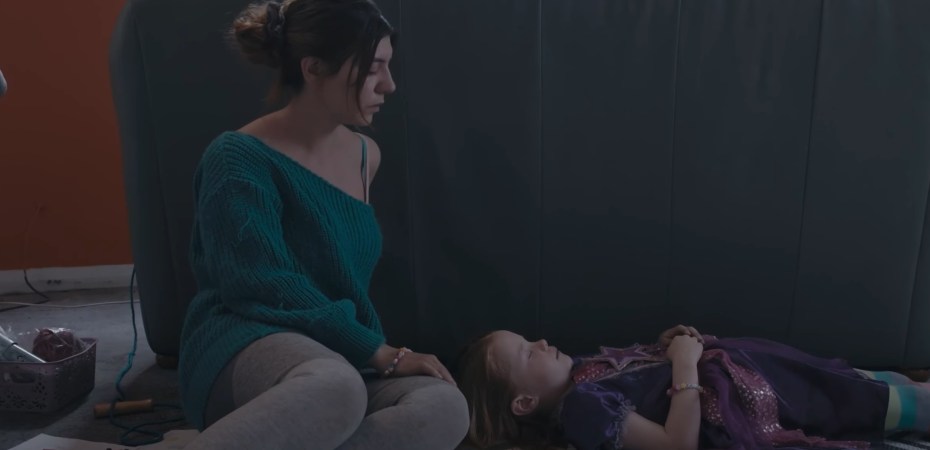
Written and directed by Mike Clarke, a desperate single mother uses her daughter’s imagination as a fragile escape from the harsh reality of their struggling life. Starring: Sophia Leanne Kelly, Anastasia Hesketh, Kelsey Dee, Jacob Anderton and Macaulay Cooper.
Considering the staggering number of people in the UK experiencing poverty, and in particular food poverty, it’s something that’s not widely discussed or featured in film and television. There have been very few strong explorations, with I, Daniel Blake, which is now almost a decade old, being one of the most harrowing. It’s a key issue that the UK faces and one that needs to be highlighted more, so it’s encouraging to see filmmakers like Mike Clarke taking on that challenge.
Undoubtedly, it is a challenge, because it’s such a poignant topic that doing it justice while avoiding trying to make it scandalous, overly gritty or soap-opera like is tricky. Clarke does a great job of staying away from those pitfalls by scaling things down and keeping a strong singular focus. There’s a simplicity to the directorial style, committing itself to realism and reflecting the dejectedness and listlessness emanating from their situation.
Something that’s matched by Sophia Leanne Kelly’s performance as Shelly, she does a fantastic job of balancing the manic desperation of holding onto her child and caring for her, with the severe lack of energy and hope. As well as tapping into the denial and reluctance to make a very difficult decision about what is best for her child, even if it’s going to be extremely painful. There’s a lot of determination and love within her performance, something that’s key to capture as people can be so quick to judge women in situations like Shelly’s.
You also have to mention Anastasia Hesketh as her daughter, Daisy. It’s not a small ask for such a young child to portray this kind of role convincingly but Hesketh does it well. Taking into account those feelings of hunger and lethargy, while still having the typical curiosity, imagination and excitement. As well as really tapping into that quintessential blind faith that children have in their parents.
The atmosphere encompasses all of that, particularly the apprehension, knowing that there isn’t much hope on the horizon and awaiting the pain and misery Shelly is facing. That melancholic air is brought through well and yet is not overwhelming. However, the style at times can feel a touch too simple, particularly the cinematography. It’s missing out on a bigger depth or level of detail, it’s decidedly tempered and neutral. The final scenes also have a distinctly purposeful nature to them that doesn’t come across entirely organically, they can feel too structured.
Make Believe movingly tackles a vital issue for the UK, highlighting the struggle that millions of people are experiencing today, and the lack of resources and options they have. Sophia Leanne Kelly gives a strong performance to highlight the dire nature of the situation while keeping it understated and natural. She’s well supported by Anastasia Hesketh. You can sense how each of the filmmakers’ choices have kept a key focus on reality, making sure to drive home that this is an everyday occurrence.
Mike Clarke builds a touching sadness and melancholy that permeates the air of the film. However, there are a few choices that hold it back from packing that big final punch, not quite holding the weight and consequence it’s going for but you can see that they are coming from a place that’s trying to be sensitive to the topic.
 FilmCarnage.com