
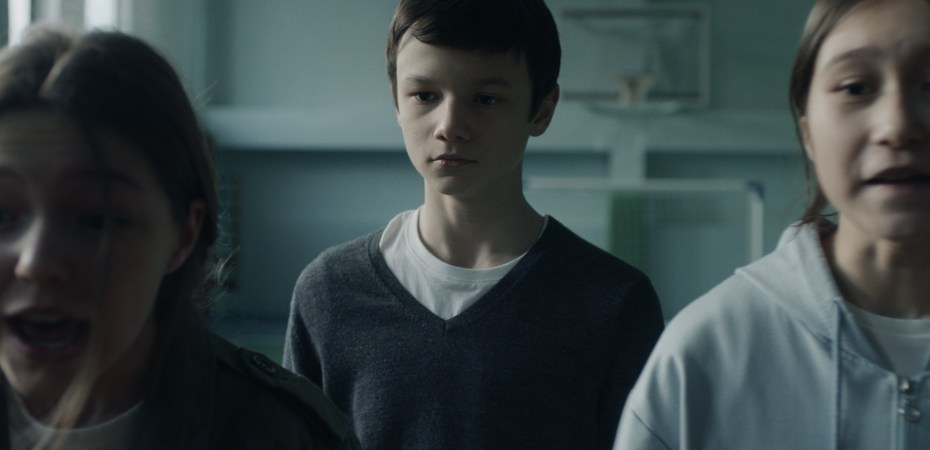
Written and directed by Demitri Zujew, in a neat classroom, a distinguished principal dazzles the local TV crew with achievements that make her school the best in the entire district. Meanwhile, outside the camera’s frame, her students are executing their own take on “proper socialization”. Starring: Platon Kuzmich, Arseny Inyutin, Khelga Filippova, Anna Zaykovskaya, Dmitrii Bashniak, Yulia Konukhova and Valentina Nikitina.
With Netflix’s Adolescence opening up the conversation around the responsibility of adults to guide young men and shield them from violent influences, it’s the perfect time to watch Crease. Instead of misogyny, Demitri Zujew is exploring social pressures and bullying, as well as how education has fallen victim to politics and image. It’s a smartly written script to juxtapose how the school staff make a dedicated effort to portray their school as a positive, nurturing environment, while the problems they’re claiming do not exist, are in fact happening a few steps away.
It’s an excellent example of how our society has skewed efforts towards public image and protecting resources, instead of actual education and support for children. Zujew nicely adds a backdrop of violent video games, complicated home life and boys idolising people like Conor McGregor whose violence against women and anti-social behaviour is well documented. Crease does well to capture the nuance of this topic, children are often portrayed in a way that doesn’t do justice to their complexity. So, it’s great to see Zujew tapping into the minefield of pressures and subconscious influences found in bringing up boys and attempting to turn them into respectful young men.
Especially as it feels like Crease is coming from the children’s perspective, which was a strong choice to fit with the message of the film, to put the children first. The scenes following the principal are unquestionably key to the plot and tone, but they ultimately feel in service of telling Maxim (Platon Kuzmich) and Petya’s (Arseny Inyutin) story.
One that is excellently injected with tension, particularly through Zujew’s use of close, detailed shots which add a lot of depth. Something which is elevated further by the use of sound, the clarity in quieter moments, such as capturing the noise of simply folding paper, really boosts the atmosphere. As well as the score (by Konstantin Poznekov) which has a brilliant build to it, adding an ominous touch to the opening then evolving with the emotions of the film.
All of that in turn is paired beautifully with the cinematography from Natalia Butova, it’s sharp and layered. Butova manages to blend the youthful nature of Crease with the weight of its topic to create an aesthetic that’s compelling and refined. On top of strong editing work from Oleg Korneev, who does a wonderful job of creating a meaningfully timed back and forth between the adults and children, which expands the tone.
All of those efforts do well to support another key factor in building Crease’s emotional foundation, which is the performance from Platon Kuzmich. He gives a strong, moving portrayal of a boy who’s on the verge of being set down the wrong path. Kuzmich really captures the susceptibility of that age, the desire to fit in and to avoid ridicule, no matter the cost. It’s a performance of few words so it speaks to the quality that it has a lot to say, Kuzmich has a genuinely absorbing presence. The rest of the cast are also superb, particularly Arseny Inyutin and Khelga Filippova, but it’s Kuzmich who really stands out.
Crease is a touching exploration of the pressures boys face and the importance of receiving support and guidance from the adults in their lives. As well as portraying how the modern obsession with public image can eradicate that support. Demitri Zujew’s directorial style is well thought out to match the complexity of the story. The editing, cinematography and score are all strong work, building an engrossing atmosphere of tension. Platon Kuzmich gives an impressive performance, and every element comes together to create a smart, moving short film.
 FilmCarnage.com