
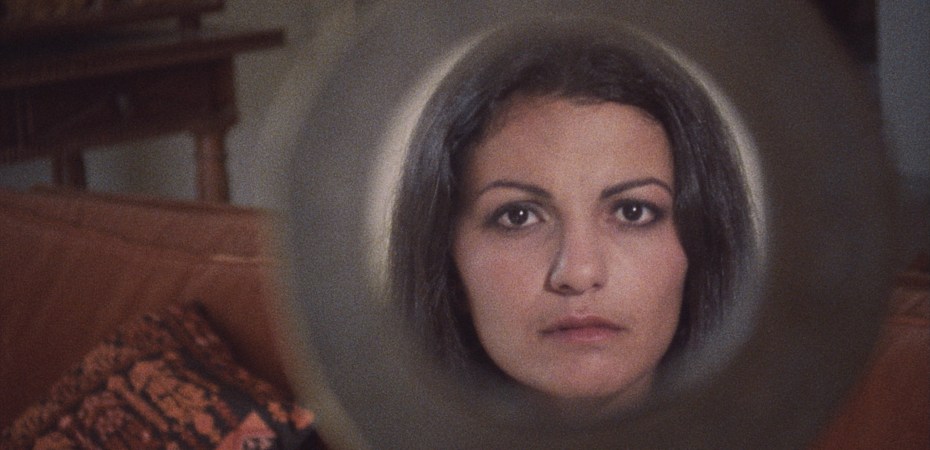
Directed by Heiny Srour, drawing on the Arab heritage of oral tradition and mosaic pattern, Leila and the Wolves is an exploration of the collective memory of Arab women and their hidden role in history throughout the past half century both in Palestine and in Lebanon. Starring: Rafik Ali Ahmad and Nabila Zeitouni.
To start with, the fact that Heiny Srour made Leila and the Wolves in the 1980s was a bold move. We’re still today discussing issues of creating film that has a critical edge of these ultra-traditional, patriarchal societies and the dangers it can hold. So, to make a film like this forty years ago is really something special. It also feels genuinely ahead of its time, the experimental edge, the use of recreation and blurring those lines of reality to portray a universal experience for Arab women.
Unsurprisingly, Leila and the Wolves has a great deal to say and most of it doesn’t have to be said out loud. Simply watching the experiences of these women and how they used misogyny to cloak their organisation and war efforts speaks volumes. It’s unexpectedly satisfying to watch them so cleverly subvert expectation in their favour. It does make you wonder how much a woman could get away with when so many men assumed women were incapable of anything but domesticity.
There’s a really interesting mix of straightforward story and exploring the metaphorical, weaving together the experiences of the past with the foresight of the future. It’s an extremely unusual style for a documentary of its era and in a fascinating way. There’s an impactful atmosphere of contemplation, the film holds itself with a very specific power and presence. The restoration work helps to really bring out the textures without making it feel dated, it almost feels as though it could have been made today.
Sadly, another part of the reason why it feels as if it could have been made much more recently is because the themes are all still so relevant. It’s distressing to explore how women have been fighting for progress for decades and the needle hasn’t moved very far at all in many parts of the world. It adds an even bigger depth to everything that Heiny Srour has to say.
Leila and the Wolves was strikingly ahead of its time, Heiny Srour created something unique which still resonates today. Srour opens up a whole new perspective of war and the brilliant ways that women contributed which are not spoken of anywhere near enough. It’s simultaneously highlighting the experience of living in a misogynistic society and how to take advantage of it. Not only that but it has an artistic style, throwing the rule book out of the window but impressively never losing touch with reality.
 FilmCarnage.com
[…] and important to see it in Threads of a Revolution. It’s slightly reminiscent of scenes seen in Leila and the Wolves, portraying the female experience of war and desire for equality and […]
LikeLike